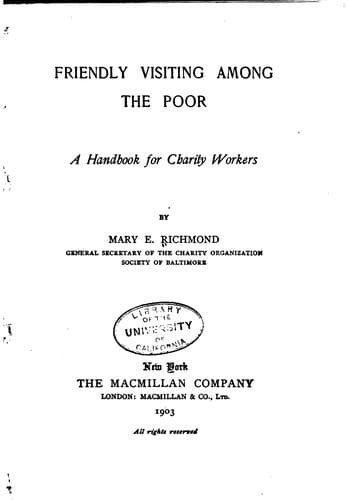
Friendly Visiting among the Poor: A Handbook for Charity WorkersRichmond, Mary Ellen
General
Friendly Visiting among the Poor: A Handbook for Charity Workers
Richmond, Mary Ellen
Friendly visiting
It has been said that, in the effort to establish friendly relations
with a poor man, often the greatest lack is a common topic. Here is at
least one topic that rich and poor have in common. Here it will be
found too that they have many grievances in common, and what makes a
better beginning for a friendly relation than a common grievance?
Another common topic, and a related one, is the news of the day. More
often than not, even the very poor read the daily papers.
Beside the ward politician, the saloon-keeper, and the policeman, there
are others who take an interest in the breadwinner. If he is injured,
or his property is injured, there are third-rate lawyers ready to bring
suit for half the proceeds--an unduly expensive arrangement for the man
that has a good claim. If he would save, there are agents of unsound
financial schemes ready to take advantage of his ignorance. If he
would borrow, there are {24} chattel-mortgage sharks ready to burden
him with a debt at ruinous interest. If he would buy, there are
instalment dealers ready to tempt him into buying more than he can
afford, and ready to charge two prices for their wares. Whole
industries are created to take advantage of his lack of shrewdness, and
every effort of his to get on, to get out of the old groove, is
resisted by such agencies. Surely, if any one stands in need of a
friend, who will patiently strive to see the world through his eyes,
and yet will have the courage to tell him the plain truth, it is the
breadwinner.
But that picture would be a distorted one which represented the poor
man as friendless save for the politicians. His neighbors and
companions are in no position to protect him from the foes I have
mentioned, but their neighborliness is none the less genuine. Most
patient and long-suffering of neighbors are the small landlords who
sublet. The tradesmen in poor neighborhoods are also heavy losers.
When a family applies for the first time to a church or charity, it
often means that they have been aided most generously for a long {25}
time by neighbors and small dealers. Sometimes one happens upon the
very best and most thoughtful charity given in this way. A Boston
worker tells of a street-car conductor, not only supported through the
winter by his fellow-conductors, but faithfully nursed by them at
night, each one taking turns after the long day's work. Such glimpses
as this show us how queer is our usual charitable perspective, in
which, as in a picture on a Chinese fan, we see the church steeple in
the middle distance and the church visitor looming large in the
foreground, while the poor little object of charity, quite helpless and
alone save for us, huddles in a corner. The fact is that every life
has a background, if we will but take the trouble to see and understand
it: all the barrenness is in our own imaginations.
Public-domain text, read in full here on John Shaqi.
Reviews
Reviews
No reviews yet
Be the first to share your thoughts on this work.
Join the Discussion
Join the discussion
Sign in to leave a comment or review.
Sign InorCreate an account