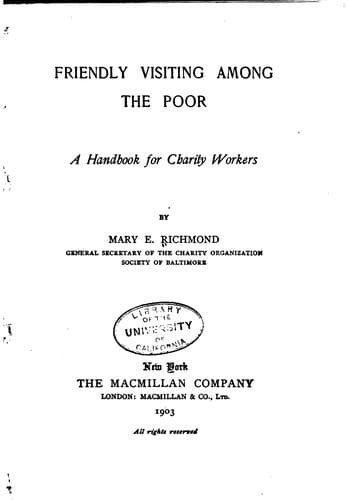
Friendly Visiting among the Poor: A Handbook for Charity WorkersRichmond, Mary Ellen
General
Friendly Visiting among the Poor: A Handbook for Charity Workers
Richmond, Mary Ellen
Friendly visiting
It is well to realize that much of the political corruption of our
large cities may be traced to the simple fact that the poor man is like
ourselves: he follows the leaders personally known to him, and to whom
he is personally known. He is sometimes a venal voter, but more often
he is only an ignorant voter, who, while innocently following the man
that has taken the trouble to do him a favor or to be socially
agreeable to him, is handicapping himself and his children with dirty
streets, an unsanitary home, an overcrowded school, an insufficient
water supply, {21} blackmailing officials, and all those other abuses
of city government which press with peculiar hardship upon the poor.
The question of municipal reform is inextricably connected with any
effort to improve the condition of the poor in their homes, and no
charity worker can afford to ignore this connection.
In "Problems of Modern Democracy," Mr. E. L. Godkin says: "Nothing is
more surprising in the attempt to deal with the problems of urban life
than the way in which religious and philanthropic people ignore the
close connection between municipal politics and the various evils about
which they are most concerned. All the churches occupy themselves, in
a greater or less degree, with the moral condition of the poor.
Charitable associations spend hundreds of thousands every year in
trying to improve their physical condition. A conference of Protestant
ministers met in this city two years ago to consider the best means of
reviving religious interest among the working classes and inducing a
larger number of them to attend church on Sundays. Of course these
gentlemen did not {22} seek an increase in the number of church-goers
as an end in itself. The Protestant churches do not, as the Catholic
church does, ascribe any serious spiritual efficacy to mere bodily
presence at religious worship. Protestant ministers ask people to go
to church in the hope that the words which they will hear with their
outward ears may be so grafted inwardly in their hearts that they may
bring forth the fruit of good living. What was remarkable in the
debates of this conference, therefore, was the absence of any mention
of the very successful rivalry with religion which, as an influence on
the poor and ignorant foreign population, politics in this city carries
on. The same thing may be said, _mutatis mutandis_, of the charitable
associations. No one would get from their speeches or reports an
inkling of the solemn fact that the newly arrived immigrant who settles
in New York gets tenfold more of his notions of American right and
wrong from city politics than he gets from the city missionaries, or
the schools, or the mission chapels; and yet such is the case. I
believe it is quite within the truth to {23} say that, as a moral
influence on the poor and ignorant, the clergyman and philanthropist
are hopelessly distanced by the politician." [2]
Public-domain text, read in full here on John Shaqi.
Reviews
Reviews
No reviews yet
Be the first to share your thoughts on this work.
Join the Discussion
Join the discussion
Sign in to leave a comment or review.
Sign InorCreate an account