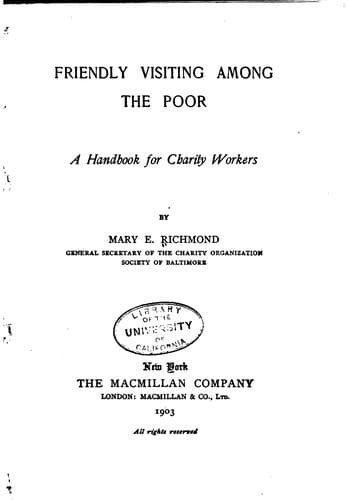
Friendly Visiting among the Poor: A Handbook for Charity WorkersRichmond, Mary Ellen
General
Friendly Visiting among the Poor: A Handbook for Charity Workers
Richmond, Mary Ellen
Friendly visiting
It has been claimed that only men and men of business experience can be
successful friendly visitors where the head of the family is concerned;
that, in matters of employment especially, a woman visitor is not
capable of giving sound advice. It is undoubtedly true {42} that such
work could be better done if more men, instead of contenting themselves
with service on charitable boards, would take the trouble to become
personally acquainted with a few poor families. This would be better
for the boards and better for the men that are charitable trustees.
But the woman visitor need not despair. It is true that she could do
her work better, as will appear in this book, if she were in her own
person a lawyer, a sanitary engineer, a trained cook, a kindergartner,
and an expert financier; but she may be none of these things and still
be a very good friendly visitor. When legal complications arise, she
will go to some friend who is a lawyer; when the children get into
trouble, she will consult a teacher, or an agent of the children's aid
society, and, in the same way, the matter of employment will send her
to a business man, or some one who can advise her, when her own store
of experience is too scant. The poor man often has a mean opinion of
the judgment of "charitable ladies," and this opinion has not always
been without a degree of justification; but the visitor who {43} takes
the trouble to go on Sunday and get acquainted with the men folk, or
makes occasion for them to come to her house from time to time, who
proves herself, moreover, not without resource or common sense as
emergencies arise, will soon overcome this prejudice and become the
friend of every member of the family.
Collateral Readings: "The Settlement and Municipal Reform," James B.
Reynolds in Proceedings of Twenty-third National Conference of
Charities, pp. 138 _sq_. "Benevolent Features of Trades-Unions," John
D. Flannigan in the same, pp. 154 _sq_. "The Ethical Basis of
Municipal Corruption," Miss Jane Addams in "International Journal of
Ethics," for April, 1898. "The Workers," Walter A. Wyckoff. "Working
People and their Employers," Washington Gladden. "Problem of the
Unemployed," Hobson. "The Unemployed," Geoffrey Drage. "Korbey's
Fortune," William T. Elsing in "Scribner's," Vol. XVI, pp. 590 _sq_.
[1] "Rich and Poor," p. 211.
[2] pp. 141 _sq_.
[3] "Charities Record," Baltimore, Vol. I, No. 6.
[4] "Rich and Poor," pp. 138 _sq_.
[5] pp. 242 _sq_.
[6] See Warner's "American Charities," pp. 177 _sq_.
[7] George Eliot in "Daniel Deronda."
[8] pp. 22 _sq_.
[9] "Charities Review," Vol. II, p. 54.
[10] p. 11.
[11] Thirteenth Report of Boston Associated Charities, p. 42.
[12] See "Charities Review," Vol. VI, pp. 402 _sq_.
{44}
CHAPTER III
THE BREADWINNER AT HOME
Public-domain text, read in full here on John Shaqi.
Reviews
Reviews
No reviews yet
Be the first to share your thoughts on this work.
Join the Discussion
Join the discussion
Sign in to leave a comment or review.
Sign InorCreate an account