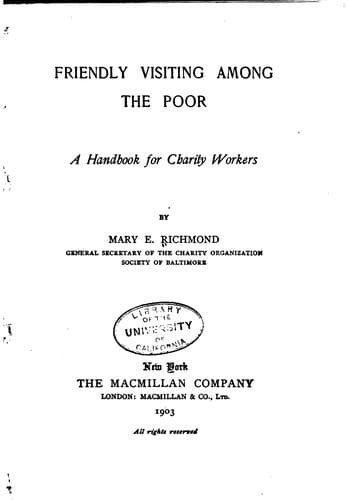
Friendly Visiting among the Poor: A Handbook for Charity WorkersRichmond, Mary Ellen
General
Friendly Visiting among the Poor: A Handbook for Charity Workers
Richmond, Mary Ellen
Friendly visiting
We have considered the breadwinner as worker, neighbor, and citizen; we
now turn to the breadwinner as husband and father. It has been said
that the home is not only the true unit of society, but that it is the
charitable unit as well, and that when we deal with anything less than
a whole family, we deal with fractions. Much of our charitable work is
still fractional. It not infrequently happens, for instance, that the
members of one poor family will come in contact with dozens of
charitable people representing many forms of charitable activity, and
that none of these will ever have considered the family as a whole.
The Sunday-school teacher, the kindergartner, the day nursery manager,
the fresh air charity agent, the district nurse, the obstetric nurse,
the church almoner, the {45} city missionary, the relief agent, the
head of the mothers' meeting, the guild teacher, the manager of the
boys' brigade or girls' friendly,--all these will have touched the
family at some point, but will never have taken the trouble to make a
picture of the family life as a whole, and of the effect of their
charity upon it. They may have assumed important responsibilities now
and again, home responsibilities that belonged primarily to members of
the family, and helped to hold the family together; but the chances are
that they will none of them have worked continuously or thoroughly
enough to learn from their blunders or to repair their mistakes.
I have mentioned home responsibilities. Let us consider, for a moment,
what these are. They have an old-fashioned and conservative sound, but
the fundamental facts of life are old-fashioned. The man is still the
head of the normal family, and, as the head, still owes his best
endeavor to secure for the other members of the family the means of
subsistence. The wife's part in the family is to transform the means
provided into a home. The children, {46} for their part, should be
teachable and obedient; and, as their own strength waxes and their
parents' wanes, they should stand ready to provide for father and
mother both the means of subsistence and the home environment. These
are the prosaic but fundamental elements of home life, and, when they
are lacking, neither the marriage ceremony, nor the sanctions of law
and custom, can prevent the home from becoming a sham home, a breeding
place of sin and social disorder.
Public-domain text, read in full here on John Shaqi.
Reviews
Reviews
No reviews yet
Be the first to share your thoughts on this work.
Join the Discussion
Join the discussion
Sign in to leave a comment or review.
Sign InorCreate an account