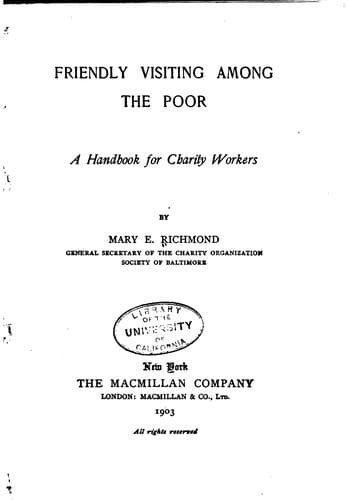
Friendly Visiting among the Poor: A Handbook for Charity WorkersRichmond, Mary Ellen
General
Friendly Visiting among the Poor: A Handbook for Charity Workers
Richmond, Mary Ellen
Friendly visiting
It is my misfortune that, in attempting to meet the needs of those who
visit the poor, I must dwell more upon the difficulties than upon the
encouragements of such work. There are many poor homes where every
essential element of home life exists. The home may be of the humblest
sort,--it may be in one room,--but, to the best of his ability, the man
is struggling to provide for his family; the woman is striving to make
the little shelter homelike; and the children are learning that, out of
the simplest elements, a certain measure of peace, orderliness and
growth may be won. The home relation is right, and, though sickness,
{47} industrial depression, accident, or some other of the misfortunes
that assail us from without may have made charitable relief necessary
for a long time, the elements of successful charitable aid are there,
because the home life _works_ with the visitor to win back health and
independence.
There is a deep satisfaction in protecting such families from the
careless, patronizing charity of the thoughtless almsgiver, whose
unsteady hand would give them a feast to-day and a famine to-morrow.
There is deep satisfaction in cooperating with such families to conquer
difficulties. There is a deeper satisfaction, however, in turning a
sham home into a real one; in teaching the slatternly, irresponsible
mother the pleasure of a cleanly, well-ordered home; in helping a man
who has lost his sense of responsibility toward wife and children to
regain it. Even at the risk of drawing a too gloomy picture, I dwell
in this chapter, therefore, upon the husband and father who is either
lazy or drunken or both.
The married vagabond has many {48} characteristics of the single
vagabond or tramp, though he is usually less enterprising. His is a
type peculiar to our large cities, where political, industrial, and
charitable conditions have helped to make him what he is. There is a
sense in which he is not responsible for his faults; but there is a
sense in which we are none of us responsible for ours, and when we are
once permanently committed to this view of ourselves, there is no
health in us. To treat the married vagabond as not responsible, is
only to increase his irresponsibility.
"One man I know who has done hardly a stroke of work for years," says
Mrs. Bosanquet; "during his wife's periodical confinements he goes off
on the tramp, leaving her to take her chance of charity coming to the
rescue, and returns when she can get to work again. I have known
fathers who would send their hungry children to beg food from their
neighbors, and then take it to eat themselves; and one I have known who
would stop his children in the street and take their shoes from their
feet to pawn for drink. The negative attitude of a man to his own
family is {49} an impossible one; if responsibility disappears, it will
be replaced by brutality." [1]
Public-domain text, read in full here on John Shaqi.
Reviews
Reviews
No reviews yet
Be the first to share your thoughts on this work.
Join the Discussion
Join the discussion
Sign in to leave a comment or review.
Sign InorCreate an account