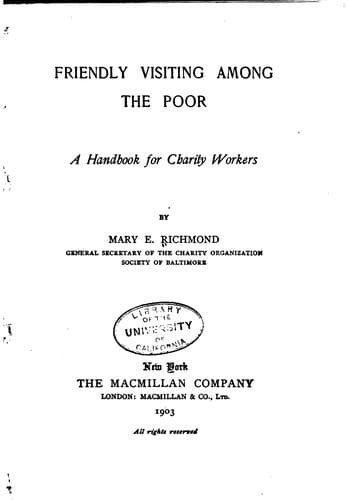
Friendly Visiting among the Poor: A Handbook for Charity Workers — John Shaqi
Friendly Visiting among the Poor: A Handbook for Charity WorkersRichmond, Mary Ellen
General
Friendly Visiting among the Poor: A Handbook for Charity Workers
Richmond, Mary Ellen
Friendly visiting
In many states there are laws for the punishment of the man that will
not support his family. Some of these enactments are of very little
use, but several of the New England states have effective laws.[4]
When a complete cutting off of charitable supplies fails to bring a man
to some sense of his duty, the visitor should try to have him punished
by the courts. The evidence of one who has faithfully visited a family
for a long time is very valuable in such cases, though conviction is
often difficult to secure for lack of the wife's testimony. If the
married vagabond that has been punished is still incurably lazy and
irresponsible, the visitor should not allow his desire to reform the
man to stand in the way of the best interests of the children, born and
unborn. The wife's duty to her husband is a very sacred one, But so is
her duty to her children. When {54} all other measures fail, the home
should be broken up.
Only those who have had wide charitable experience will be likely to
consider this separation of man and wife justifiable. Says Mrs.
Josephine Shaw Lowell: "I have not the slightest doubt that it is a
_wrong_; and a great wrong, to give help to the family of a drunkard or
an immoral man who will not support them. Unless the woman will remove
her children from his influence, it should be understood that no public
or private charity, and no charitable individual, has the right to help
perpetuate and maintain such families as are brought forth by drunkards
and vicious men and women." [5]
It is unnecessary to say that the advocates of separation as a last
resort do not approve of divorce, which would only multiply sham homes.
They recognize in certain cases "the sad fact of incurability," and are
prepared to take courageous measures in order that the innocent may not
suffer with the guilty.[6]
{55}
Public-domain text, read in full here on John Shaqi.
Reviews
Reviews
No reviews yet
Be the first to share your thoughts on this work.
Join the Discussion
Join the discussion
Sign in to leave a comment or review.
Sign InorCreate an account