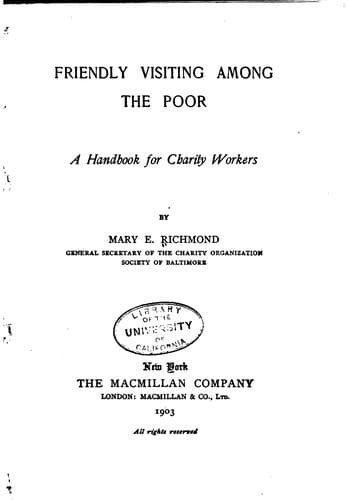
Friendly Visiting among the Poor: A Handbook for Charity WorkersRichmond, Mary Ellen
General
Friendly Visiting among the Poor: A Handbook for Charity Workers
Richmond, Mary Ellen
Friendly visiting
The following history of a Baltimore married vagabond will illustrate
the need of separation in certain cases: Several years ago the
Baltimore Charity Organization Society made the acquaintance of the
family of a good-looking German shoemaker, who had married a plain,
hard-working woman some years his senior. Soon after their marriage he
began to neglect his work, and, depending more and more on his wife's
exertions for his support, he took to drink. Child-bearing often
incapacitated the wife for work, and church and charitable friends
aided at such times. When the sixth child was a year old, he deserted
his family for a while, but came back again, after having been in jail
for disorderly conduct. The Charity Organization Society, seeing no
chance of reforming the man, suggested that his wife leave him, but the
German pastor strongly objected to any separation of man and wife, and
nothing was done. A discouraging aspect of the situation was that the
man taught his children to deceive the hard-working mother. When the
seventh baby was born, and charity had supplied a registered nurse,
baby linen, {56} a doctor, fuel, and food, it was discovered that the
man had sold the fuel supplied by the relief society, and had gone on a
spree. He was a good workman, and could always have work when sober,
but even when at work he neglected to provide properly for his family.
Stung at last into active resistance, his wife had him arrested for
non-support. While the man awaited trial, the Charity Organization
Society removed his family, found work for the wife where she could
keep three of her children, placed one with a relative, and two others
temporarily in institutions. When he was released, he had no family to
attract charitable aid, and was thrown, for the first time in many
years, entirely upon his own resources.
Many good people may think that to deprive a man of family ties is to
hasten his downfall; but what downfall could be more complete than the
downfall of the man who not only permits his wife to support him, but
abuses her and his children? In making this no longer possible we are
sometimes doing the one thing that can be done to save him from {57}
spreading the contagion of his brutality, and so assuming a still
heavier burden of sin.
Public-domain text, read in full here on John Shaqi.
Reviews
Reviews
No reviews yet
Be the first to share your thoughts on this work.
Join the Discussion
Join the discussion
Sign in to leave a comment or review.
Sign InorCreate an account