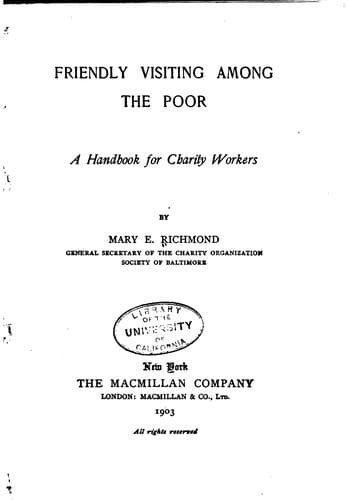
Friendly Visiting among the Poor: A Handbook for Charity Workers — John Shaqi
Friendly Visiting among the Poor: A Handbook for Charity WorkersRichmond, Mary Ellen
General
Friendly Visiting among the Poor: A Handbook for Charity Workers
Richmond, Mary Ellen
Friendly visiting
Where the breadwinner is disabled, or the woman is a deserted wife or
widow, work is, of course, necessary. We must distinguish, however,
between the deserted wife and the wife whose husband chronically
deserts her, until her condition attracts the charitable help that he
returns to share. Widows with children belong to a class with which
charity has dealt too harshly in the past. When the woman is incapable
of supporting all her children, and this is usually the case, charity
has either allowed her family to depend upon insufficient doles and so
drift into beggary, or else has put all the children in orphanages. If
the mother is a good mother, capable with help of rearing her children
to independence and {74} self-support, this latter is not only a cruel
but a wasteful method. As charity becomes more discriminating and
resourceful, it will be possible to organize pensions for widows of
this class, though these pensions will need the careful oversight of a
visitor, who should see that the children are taught to bear the family
burden as they become older.
There is great diversity of opinion about the value of mothers'
meetings for women whose home duties prevent them from attending church
on Sunday. If these meetings confined themselves to providing what the
church service provides,--a chance for spiritual uplifting and
refreshment,--there could be no possible objection to them; but,
unfortunately, many mothers' meetings strive to attract and hold
members by such small devices as paying them for very bad sewing, or
making small gifts, or selling things below cost. These attractions,
small as they are, lead many women to neglect their home duties, and it
is no unusual thing for one woman to belong to three mothers' meetings
of three different denominations, which take her away {75} from home
three afternoons in the week. The atmosphere of patronage and
"sprinkling charity" that is so common in these meetings, distinctly
lowers the self-respect of the women; before very long they learn to
write begging notes or send begging messages to "the ladies" in charge,
and the place that should be for them a source of spiritual strength
becomes merely a source of supplies.
Public-domain text, read in full here on John Shaqi.
Reviews
Reviews
No reviews yet
Be the first to share your thoughts on this work.
Join the Discussion
Join the discussion
Sign in to leave a comment or review.
Sign InorCreate an account