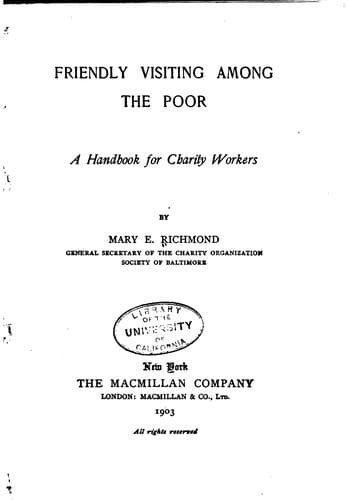
Friendly Visiting among the Poor: A Handbook for Charity WorkersRichmond, Mary Ellen
General
Friendly Visiting among the Poor: A Handbook for Charity Workers
Richmond, Mary Ellen
Friendly visiting
Collateral Readings: "The Lustig's" and "Corinna's Fiametta," Mrs.
Schuyler Van Rensselaer in "One Man who was Content and Other Stories."
"Practical Sanitary and Economic Cooking" (adapted to persons of
moderate and small means), Mrs. Mary Hinman Abel, published by American
Public Health Association, Rochester, N.Y. "Foods: Nutritive Value and
Cost," by W. O. Atwater in Farmer's Bulletin No. 23 of United States
Department of Agriculture. "Dietary Studies in New York City," W. O.
Atwater and Charles D. Woods in Bulletin No. 46 of United States
Department of Agriculture. The Health Department of New York City will
soon publish leaflets prepared by experts, which will contain simple
directions about buying and preparing food. "The Le Play Method of
Social Observation," "American Journal of Sociology," Vol. II, No. 1.
"Treatment of Widows and Dependent Children," Mrs. L. Wolcott in
Proceedings of Fifteenth National Conference of Charities, pp. 137
_sq_. "Girls in a Factory Valley," Mrs. Lillie B. Chace Wyman in
"Atlantic," Vol. LXXVIII, pp. 391 _sq_. and 506 _sq_.
[1] Mrs. Roger Wolcott in Proceedings of International Congress of
Charities at Chicago, Volume on "Organization of Charities," p. 110.
{76}
CHAPTER V
THE CHILDREN
The visitor in the homes of the poor whose chief concern is with
questions of material relief often overlooks the children entirely,
unless they are large enough to be forced into the labor market and
made to contribute toward the family income. In charity meetings,
where visitors get together to discuss the difficulties of individual
families, it will often happen that the children are not mentioned. On
the other hand, there is a large class of charity workers who concern
themselves with the children only, and a strongly marked tendency of
modern charity is to treat the children of the poor quite apart from
and without any relation to their home life. "We constantly hear it
said," writes Mrs. James Putnam, "that we cannot help the older ones,
but that we must save the {77} children. It seems clear to me that to
help one without the other is usually an impossible task. Their
interests are too closely bound together." [1]
There is always danger, in our eagerness to help the children, that we
may only encourage parents to shirk their duty. Take the admirable
charities known as day nurseries. If care is not taken to exclude all
except the children of widows, or of women whose husbands are disabled,
these will only encourage laziness in the husband, and help to bring
about that unwholesome condition in which the wife is breadwinner,
homemaker, and child-bearer.
Public-domain text, read in full here on John Shaqi.
Reviews
Reviews
No reviews yet
Be the first to share your thoughts on this work.
Join the Discussion
Join the discussion
Sign in to leave a comment or review.
Sign InorCreate an account