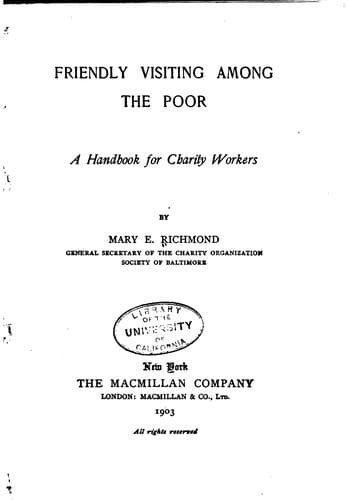
Friendly Visiting among the Poor: A Handbook for Charity Workers — John Shaqi
Friendly Visiting among the Poor: A Handbook for Charity WorkersRichmond, Mary Ellen
General
Friendly Visiting among the Poor: A Handbook for Charity Workers
Richmond, Mary Ellen
Friendly visiting
"One of our visitors went for two years to visit a widow and her
children without feeling that she accomplished anything, though the
intercourse was pleasant enough in itself. Then she heard that the
girl of thirteen was having trouble in school and was in danger of
being expelled. She went to see the teacher. {80} The girl was always
well dressed, and the teacher had no idea she was a poor girl. After
seeing the visitor the teacher touched the girl at last by talking with
her of the sacrifices her mother had made for her education, and urging
her to do her part, that her mother's hard work might not be in vain.
In this way she persuaded the girl to good behavior and kept her in
school--all because some one had visited the family for a year or two
and could speak confidently of their condition and character." [2]
No one can work among the poor in their homes without realizing the
need of compulsory education laws. There are still people here and
there who talk about the danger of educating the poor "above their
station," but those who know the poor in our large cities from actual
contact feel that over-education is the very least of the dangers that
beset them. The lack of adequate school accommodations, making it
impossible to punish truancy, is a much greater danger, and, in some
States, the absence of any compulsory education law {81} makes the
child the easy victim of trade conditions and of parental greed. The
visitor should never permit the desire to increase the family income to
blind him to the fact that the physical, mental, and moral welfare of
the child is seriously endangered by wage-earning. Where there is a
compulsory education law, he should cooperate with the truant officers
in securing its enforcement; where there is no such law, every
influence should be brought to bear upon parents to keep children in
school. The Hebrew Benevolent Society of Detroit refuses aid to
families in which the children are kept from school, and all our relief
agencies, churches included, would do well to adopt this rule.
Public-domain text, read in full here on John Shaqi.
Reviews
Reviews
No reviews yet
Be the first to share your thoughts on this work.
Join the Discussion
Join the discussion
Sign in to leave a comment or review.
Sign InorCreate an account