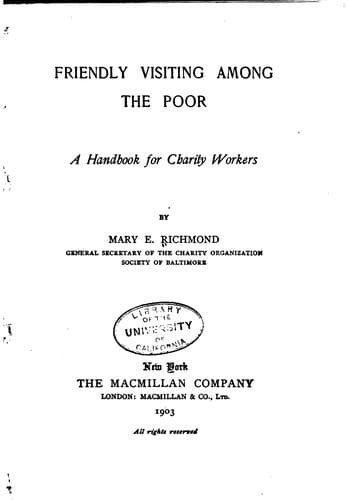
Friendly Visiting among the Poor: A Handbook for Charity WorkersRichmond, Mary Ellen
General
Friendly Visiting among the Poor: A Handbook for Charity Workers
Richmond, Mary Ellen
Friendly visiting
Some of the most intelligent and devoted workers in child-saving
agencies have sounded the note of warning on the subject of children
wage-earners. "The fact," says Mrs. Anna Garlin Spencer, "that the
world of industry has found out and established methods of labor which
can utilize the work of children to profit, gives to that world of
industry, as an upper and a nether millstone, the greed {82} of
employers and the cupidity and poverty of parents, between which the
life of the child is often ground to powder." [3] And Mrs. Florence
Kelley, writing from her experience as a factory inspector in Illinois,
says: "I do not mean that every boy is usually ruined by his work, but
I do mean that, the earlier the child goes to work, the greater the
probability of ruin. I mean, too, that there is to be gained, from a
scientific study of the working child, an irradiating side-light upon
the tramp question, the unemployed question, and the whole ramifying
question of the juvenile offender. . . . One reason that immigrants
cling so closely to the great cities is that they find there far more
opportunity to get money for their children's work. There is probably
no one means of dispersing the disastrously growing colonies of our
great cities so simple and effective as this one, of depriving the
children of their immediate cash value." [4]
{83}
Another hindrance to the proper education of the children is the habit
of keeping them from school to run errands, to carry their fathers'
dinners, or to help with the housework. The girls are often taken away
from school very early for trivial reasons.
Recent developments in child study show that many of the moral and
mental obliquities of children may be traced to physical defects. In
dealing with wayward and dull children, the visitor should bear this
fact in mind, and, either by observation or by the help of a physician,
discover wherein the child is defective. The sooner a defect is
discovered, the easier it will be to cure it, and for this reason the
visitor should learn to apply simple tests for defective sight and
hearing.
Public-domain text, read in full here on John Shaqi.
Reviews
Reviews
No reviews yet
Be the first to share your thoughts on this work.
Join the Discussion
Join the discussion
Sign in to leave a comment or review.
Sign InorCreate an account