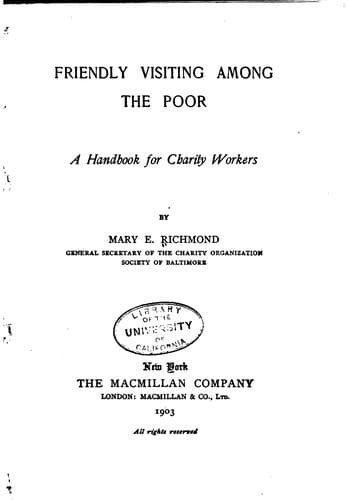
Friendly Visiting among the Poor: A Handbook for Charity Workers — John Shaqi
Friendly Visiting among the Poor: A Handbook for Charity WorkersRichmond, Mary Ellen
General
Friendly Visiting among the Poor: A Handbook for Charity Workers
Richmond, Mary Ellen
Friendly visiting
It is impossible to enter here upon the vexed question of the relative
merits of boarding-out dependent children, of placing them without pay
in country homes, or of committing them to the care of institutions,
though I cannot refrain from quoting, in passing, the opinion of Miss
Mason, for twelve years an English government inspector of boarded-out
children, that "well carried out, boarding-out may be the best way of
caring for dependent children; ill carried out, it may be the worst."
There is a very foolish saying that the worst home is better than the
best institution, but no one who knows how bad a home can be {91} or
how good an institution can be will venture beyond the statement that,
other things being equal, a home is certainly better than an
institution. The friendly visitor should make himself familiar with
what has been written on this subject, and should be prepared, in any
given case, to make the wisest selection of a home that local
conditions make possible, always remembering, of course, that his
responsibility does not end here; that he should continue to visit the
child, if it be placed within visiting distance.
The visitor should also be familiar with the local laws for the
protection of children. These usually include laws against
child-begging; against selling liquor and tobacco to minors; against
the employment of children as pedlers, public singers, dancers, etc.;
against the employment of children under a certain age for more than a
specified number of hours (or prohibiting their employment entirely);
and against the abduction or harboring of female minors for immoral
purposes.
What, above the mastery of all these details, {92} should be the
visitor's clear aim? To see to it that the children are better off
than their parents were, and are saved from the pitfalls into which the
latter have fallen; that the boys are better equipped to become
breadwinners, and the girls to become homemakers. The training given
in our public schools will often seem very inadequate, and some of us
look forward to the day when every boy and girl between the ages of six
and sixteen shall be trained to use hand and brain, when manual
training shall be part of the daily instruction of every school course.
Until this day comes, the visitor must make use of such aids as evening
classes in boys' and girls' clubs, people's institutes, and Christian
associations. A child's capabilities should be studied and every
encouragement given to his small ambitions.
Public-domain text, read in full here on John Shaqi.
Reviews
Reviews
No reviews yet
Be the first to share your thoughts on this work.
Join the Discussion
Join the discussion
Sign in to leave a comment or review.
Sign InorCreate an account