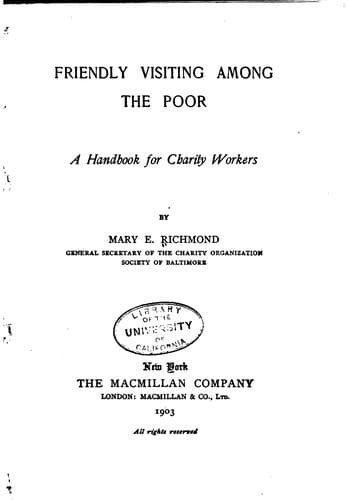
Friendly Visiting among the Poor: A Handbook for Charity WorkersRichmond, Mary Ellen
General
Friendly Visiting among the Poor: A Handbook for Charity Workers
Richmond, Mary Ellen
Friendly visiting
Much has been written about the qualifications necessary for charitable
work. It is possible to exaggerate them. Those who are unfamiliar
with the homes of the poor are likely to think it unsafe to send young
and inexperienced people into poor neighborhoods. As a matter of fact,
there are many good people in the poorest neighborhoods, and young
workers are as safe there as anywhere. In an old note-book I find that
years ago I set down the necessary qualifications of the friendly
visitor to be tact and good-will. If we consider that tact includes
knowledge, either instinctive or acquired, this may still stand. We
cannot be tactful with those whose point of view we fail to understand,
or do not even strive to understand. The best helps toward such an
understanding, and the best training for charitable work, must come
from life itself. If we take no interest in the joys and sorrows of
human beings, if we show {15} neither judgment nor energy in the
conduct of our own affairs, if life seem to us, on the whole, a flat
and unprofitable affair, then no amount of reading will transform us
into good friendly visitors. Given the tactful, kindly spirit, with a
dash of energy added, study and experience can teach us how to turn
these to the best account in the service of others. Our reading must
be supplementary to experience, of course, and can in no wise take the
place of it.
Leaving all further generalization about friendly visiting for the last
chapter, in the following pages my point of departure will be the
organization of the poor man's home rather than the organization of
charity. The head of the family as citizen, employee, husband, and
father; the wife as homemaker; the children; the family health and
recreations; the principles involved in spending and saving; the
principles of effectual relief; the relations of the church to the
poor,--these will be considered in turn. Necessarily, in a book of
this size, the attempt must be to suggest lines of inquiry and points
of view, {16} rather than to treat adequately any one part of the
subject.
Public-domain text, read in full here on John Shaqi.
Reviews
Reviews
No reviews yet
Be the first to share your thoughts on this work.
Join the Discussion
Join the discussion
Sign in to leave a comment or review.
Sign InorCreate an account