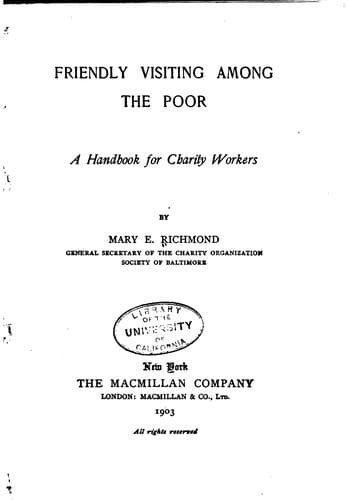
Friendly Visiting among the Poor: A Handbook for Charity WorkersRichmond, Mary Ellen
General
Friendly Visiting among the Poor: A Handbook for Charity Workers
Richmond, Mary Ellen
Friendly visiting
Collateral Readings: "Individuality in the Work of Charity," George B.
Buzelle in Proceedings of Thirteenth National Conference of Charities,
pp. 185 _sq_. "Scientific Charity," Mrs. Glendower Evans in
Proceedings of Sixteenth National Conference of Charities, pp. 24 _sq_.
Chapters on "Scientific Charity" in "Problems of American Society," J.
H. Crooker. Papers on Social Settlements in Proceedings of
Twenty-third National Conference of Charities, pp. 106 _sq_. "The
Causes of Poverty," F. A. Walker in "Century," Vol. LV, pp. 210 _sq_.
"The Jukes," Richard Dugdale. "Tribe of Ishmael," Oscar McCulloch in
Proceedings of Fifteenth National Conference of Charities, pp. 154
_sq_. "The Rooney Family," see Charles Booth's "Life and Labor of the
People," Vol. VIII, pp. 317 _sq_. "Life in New York Tenement Houses,"
William T. Elsing in "Scribner's," Vol. XI, pp. 677 _sq_. "An
Experiment in Altruism," Miss Margaret Sherwood.
{17}
CHAPTER II
THE BREADWINNER
A conference was held in one of our large cities lately of half a dozen
church and charity workers, who had been called together to make some
plan or agree upon some common principle in dealing with a certain
family, to whom charitable relief had been given in an aimless way for
many years with no good result. Three churches were represented, and
the persons present had visited and relieved the family for periods
ranging from three to ten years. Almost immediately, however, the fact
was brought out at the conference that not one of these visitors had
ever seen the man of the family, or had ever made any effort to see
him. By way of excuse one visitor said she had always understood that
the man was very good-for-nothing. But happily there is no better
dispeller of mental {18} fog than a friendly conference of those who
are in earnest, and it did not take long to convince these conferees
that the man's good-for-nothingness was, in part at least, their own
fault. I shall have occasion to speak more than once, in this book, of
the power of suggestion. Even here, where these relief visitors had
never given the head of the family a thought, they had taught him a
lesson. From their whole line of conduct he must have received the
suggestion that his neglect of his family was an affair of no
consequence.
Public-domain text, read in full here on John Shaqi.
Reviews
Reviews
No reviews yet
Be the first to share your thoughts on this work.
Join the Discussion
Join the discussion
Sign in to leave a comment or review.
Sign InorCreate an account