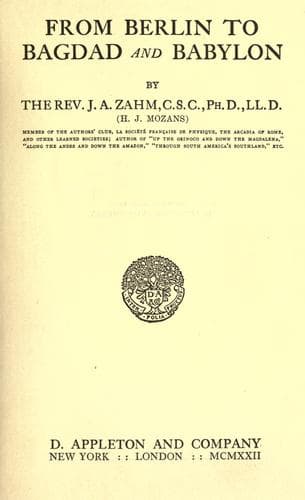
From Berlin to Bagdad and BabylonZahm, J. A. (John Augustine)
HistoryChristian
From Berlin to Bagdad and Babylon
Zahm, J. A. (John Augustine)
Middle East -- Civilization; Middle East -- Description and travel
The disastrous situation of our affairs has moved us to lay before our
dear and faithful States of Hungary the recent invasion of Austria,
the danger now impending over this Kingdom and a proposal for the
consideration of a remedy. The very existence of the Kingdom of
Hungary, of our own person, of our children and our crown is now at
stake. Forsaken by all, we place our sole resource in the fidelity,
arms and long-tried valor of the Hungarians; exhorting you, the States
and Orders, to deliberate without delay in this extreme danger, on the
most effectual measures for the security of our person, of our children
and of our crown, and to carry them into immediate execution. In regard
to ourself, the faithful States and Orders of Hungary shall experience
our hearty coöperation in all things which may promote the pristine
happiness of this Kingdom and the honor of the people.[9]
The effect of this indirect and impassioned appeal was electrical. The
assembled multitude, the _élite_ of Hungary’s nobility, instantly
drew their swords and shouted, “_Vitam et sanguinem. Moriamur pro
rege nostro Maria Theresa_”[10]--“Our blood and our life. Let us die
for our King Maria Theresa.” From this moment the entire nation rallied
to the support of their sovereign and her eventual triumph was assured.
This dramatic episode is commemorated by an imposing equestrian statue
of Maria Theresa in the Coronation Hill Platz which bears the simple
but eloquent inscription--_Vitam et sanguinem_.
The fact that Maria Theresa and her audience spoke Latin, instead of
Hungarian or German, on the memorable occasion referred to is easily
explained. For centuries Latin had been in Hungary the language of
diplomacy. Lectures in the University were given in Latin and the
language of Cicero and Virgil was spoken by the deputies in Parliament.
Indeed, until a few decades ago, every man of liberal education was
supposed to be able to write and speak Latin with ease and fluency.
“When I was a girl,” a Hungarian countess told me, “the language at
table in my father’s house was always Latin. All of us, boys and girls,
spoke it as well as our mother tongue.”
I met many Hungarian priests who spoke Latin in preference to their
native Magyar. One of them was an orator of exceptional eloquence and
could give an extemporaneous address in Latin without hesitating for a
word and always in the purest Latinity.
An Englishman who made a journey up the Danube near the middle of
the last century tells us that he heard on the steamer a “party of
Hungarian priests and a large assemblage of second-class passengers
conversing in Latin with as much facility as if it were their native
tongue.”[11]
Public-domain text, read in full here on John Shaqi.
Reviews
Reviews
No reviews yet
Be the first to share your thoughts on this work.
Join the Discussion
Join the discussion
Sign in to leave a comment or review.
Sign InorCreate an account