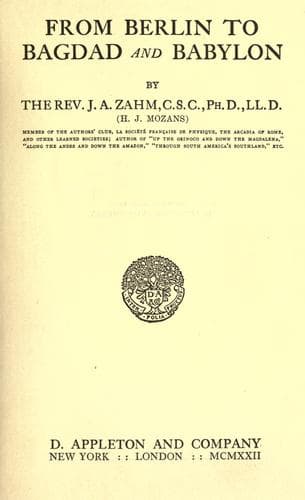
From Berlin to Bagdad and BabylonZahm, J. A. (John Augustine)
HistoryChristian
From Berlin to Bagdad and Babylon
Zahm, J. A. (John Augustine)
Middle East -- Civilization; Middle East -- Description and travel
Three years after Botta’s arrival in Mosul, Austen Henry Layard began
his memorable excavations at Nimroud, a short distance to the south
of Nineveh. So successful was he in his work here and subsequently at
Kuyunjik--Citadel of Nineveh--that he was soon able to send a larger
and a more valuable collection of antiquities to the British Museum
than that with which Botta had enriched the Louvre. Great, indeed,
was the excitement in France and England when the treasures of the
long-buried palaces of Nineveh were placed on exhibition and when
people had before their eyes tangible evidence of that famed Assyrian
capital which for more than twenty centuries had left no other trace of
its existence than a name which was a synonym of fabulous wealth and
magnificence.
In a work published shortly after Botta and Layard had electrified the
world by their startling discoveries, a well-known English scholar,
speaking of the unearthing of Nineveh, wrote:
More than two thousand years had it thus lain in its unknown
grave, when a French savant and a wandering English scholar,
urged by a noble inspiration, sought the seat of the once
powerful empire, and, searching till they found the dead city,
threw off its shroud of sand and ruin and revealed once more to
an astonished and curious world the temples, the palaces, the
idols; the representations of war and the triumphs of peaceful
art of the ancient Assyrians. The Nineveh of Scripture, the
Nineveh of the oldest historians; the Nineveh--twin-sister of
Babylon--glorying in a civilization of pomp and power, all
traces of which were believed to be gone; the Nineveh, in which
the captive tribes of Israel had labored and wept, was, after a
sleep of twenty centuries, again brought to light. The proofs
of ancient splendor were again beheld by living eyes, and, by
the skill of the draftsman and the pen of antiquarian travelers,
made known to the world.[362]
Notices like this which frequently appeared in books and periodical
literature had the effect of exciting widespread enthusiasm for
the advancement of Assyrian research. Societies were organized for
promoting excavations on a larger scale than was feasible for the first
explorers, who were greatly hampered by the lack of adequate funds, and
for giving due publicity to the work of the archæologists in the field.
The results were most gratifying, for it was not long before explorers
were investigating the mounds of Babylonia as well as those of Assyria.
Public-domain text, read in full here on John Shaqi.
Reviews
Reviews
No reviews yet
Be the first to share your thoughts on this work.
Elsewhere in the archive
Join the Discussion
Join the discussion
Sign in to leave a comment or review.
Sign InorCreate an account