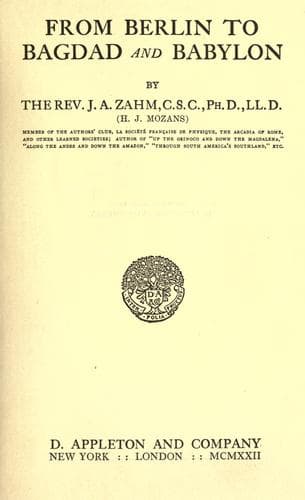
From Berlin to Bagdad and BabylonZahm, J. A. (John Augustine)
HistoryChristian
From Berlin to Bagdad and Babylon
Zahm, J. A. (John Augustine)
Middle East -- Civilization; Middle East -- Description and travel
Their little towns located in the interior, their villages,
their country homes, are the last refuges not only of the calm
but also of the patriarchal virtues which are more and more
disappearing from our modern world: loyalty and honesty without
blemish; veneration of children for parents of a kind that is
not longer known to us; inexhaustible hospitality and chivalrous
respect for guests; moral elegance and native delicacy, even
among the most humble; kindness towards all--even towards
animals; unbounded religious tolerance for whomsoever is not
their enemy; serene faith and prayer. When arriving among them
after leaving our Occident of doubt and cynicism, of noise and
scrap-iron, one feels as if suffused with peace and confidence
and believes he has remounted the course of time towards some
indeterminate epoch, near, perhaps, to the Golden Age.[135]
In Anatolia particularly are applicable the words of the English
traveler, Walpole, who, when speaking of the hospitability of the
people of Turkey, tells us that “in the East alone now do we find in
the Oda Nessafer of the village the guest-chamber of Plato. A sum
is set apart by the government for supplying these; though usually
the more wealthy traveler repays what he receives, adding a small
gratuity.”[136]
In hospitality the Osmanlis of to-day are heirs of the best traditions
of the Greeks of old who, as Homer informs us, were wont to say:
_For Jove unfolds our hospitable door:_
_’Tis Jove that sends the stranger and the poor._[137]
One of the most striking instances of Osmanli hospitality of which I
have recently heard is an experience of my good Franciscan friend,
the Reverend Paschal Robinson, Professor of History in the Catholic
University of America in Washington, D. C. Some years ago he had
occasion to travel through the greater part of Asia Minor. During the
seven months of his journey he was always the guest of the Turks, who
were all Moslems. And yet, although he was an entire stranger among
them, the generous and courteous Osmanlis everywhere received him with
the most cordial hospitality. Not only did they supply him gratis with
food and shelter, but they also provided him with the necessary means
of transportation from one place to another. And never would they
accept the slightest compensation for their services.
My actual traveling expenses during these seven months [Father
Paschal assures me] were the equivalent of only seven American
dollars. And, although the passport requirements in Turkey have
always been exceedingly strict, I never carried a passport and
nobody ever asked me for one. My habit which I always wore in
Anatolia was my passport.
Public-domain text, read in full here on John Shaqi.
Reviews
Reviews
No reviews yet
Be the first to share your thoughts on this work.
Elsewhere in the archive
Join the Discussion
Join the discussion
Sign in to leave a comment or review.
Sign InorCreate an account