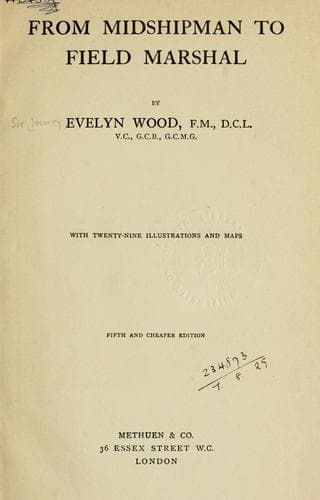
Great Britain -- History, Military -- 19th century; Marshals -- Great Britain -- Biography; Wood, Evelyn, 1838-1919
officer--not belonging to the Regiment--who had contravened my orders.
The Zulus in front of them made no stand. The young soldiers were very
steady, and expended less than two rounds of ammunition per man; but
the Zulus fled from the sight of the advancing line, and went ten paces
to one covered by our men. The Frontier Light Horse and the Dutchmen
pursued them until they climbed the Inhlobane mountain, and then after
a halt of two hours I ordered the column to fall in, and, against the
advice of some of the senior officers, read to the men the note I had
received.
We moved back as far as our camp of the previous day, and next
morning returned to our fort on the Umvolosi River. I was now in some
difficulty. I did not want to abandon Supplies, and I had 70 loads
for which I had no waggons. The Dutchmen, who were well provided with
waggons, and were themselves wonderful drivers of oxen, came to my
aid. Piet Uys and his men, who had only about 1000 lbs. weight on each
waggon, loaded up to 8000 lbs., and then we moved slowly westwards,
halting on the 28th at Venter’s Drift, where I was within reach of
firewood, our greatest want in that part of the country. There were
trees growing in the ravines south of the Ngaba Ka Hawane Mountain.
Here I received a considerate note from Lord Chelmsford, giving me
a brief account of the disaster at Isandwhlana, and telling me I
had a free hand to go anywhere or adopt any measures I might think
best, ending: “You must now be prepared to have the whole of the Zulu
Army on your hands any day.... No. 3 Column, when re-equipped, is to
subordinate its movements to your column. Let me know how it can assist
you.” I replied to Lord Chelmsford on the 31st January that I was in
a position on Kambula Hill which I anticipated being able to hold
even against the whole of the Zulu Army. I understood he did not wish
me to incur risk by advancing, and I would not move unless it became
necessary to do so in order to save Natal.
In spite of the carriage for stores lent to us by the Dutchmen, we
had some trouble before we succeeded in finding a good military and
sanitary Position, and even to men who did not feel much compassion for
oxen, to make them pull 8000 lbs. through swamps is trying to their
feelings as well as to the oxen’s hides. It has often been a wonder
to soldiers in South Africa how the Dutch, under Pretorius and other
leaders forty years earlier, took waggons up and down mountains which
appear to us impracticable for wheel traffic, but the maximum weight in
a waggon on Commando was 1500 lbs., five adults being allowed a waggon
between them, which of course made a great difference on a bad track.
The difficulties of transport caused me to halt every second or third
day, as I was obliged to make two journeys with my loads, and I soon
had warning that I could not remain in the valley of the Umvolosi, by
the loss of horses and oxen, followed by that of a man of the 90th,
who died of very rapid enteric fever.
Public-domain text, read in full here on John Shaqi.
Reviews
Reviews
No reviews yet
Be the first to share your thoughts on this work.
Elsewhere in the archive
Join the Discussion
Join the discussion
Sign in to leave a comment or review.
Sign InorCreate an account