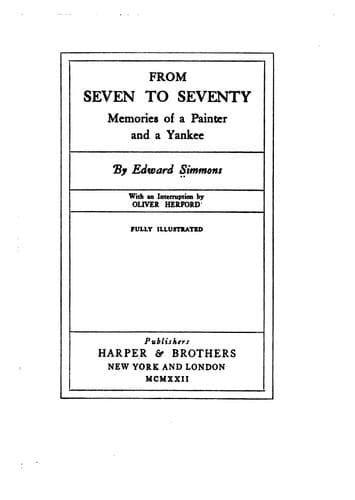
From Seven to Seventy: Memories of a Painter and a YankeeSimmons, Edward
General
From Seven to Seventy: Memories of a Painter and a Yankee
Simmons, Edward
Artists -- Biography
Another instance of his very highly developed sense of justice is the
case of General Loring, who was supposed to be a traitor to the
antislavery movement. The lesser minds raved and swore they would never
speak to him again. Whittier wrote a poem about him. Emerson gave no
tongue, but one evening after a Lyceum lecture in Salem he saw the
general in line with those who wished to congratulate and shake hands
with him. Speaking very distinctly so that everyone about could hear, he
said, taking the proffered hand:
“General Loring, if what I hear of you be true—I shake hands with you
under protest.”
The last time I saw Mr. Emerson was in 1879. I was in my twenty-seventh
year, had just returned from California, and was spending some time in
Concord before going abroad. Charles H. Davis, the painter, was visiting
me at the Old Manse, and we both went over and supped with him. He
seemed much older, but was still that example of perfect serenity I had
known as a boy. His memory was beginning to fail him, which made him a
bit querulous, but his daughter Ellen supplied it whenever she could.
For example, he forgot that he had ever seen Tom Taylor’s tribute, or
apology, to Lincoln, in _Punch_—in spite of the fact that it is included
in the Parnassus—and read it to us, at my request, with astonishment and
delight. He read beautifully, and his voice retained all of its old
hypnotic quality.
While his memory failed in the detail of names and places, he still
retained, in most cases, his fascinating mode of expression, and the
process of thought was still there. He said the night Davis and I were
there—
“Last week, it was the day ... the day that ... who was it was here?
Ellen, can you remember? Oh! It was our religious friend.” He referred
to Whittier.
He asked, upon going out for a walk, “Where is that thing everybody
borrows and no one ever returns.” He meant an umbrella and had forgotten
the name.
This story was told me by my mother. They knew (the women) that
Emerson’s opinion of Longfellow was the same as theirs—the Bromides—and
that the two men, of course, loved and admired each other—which they did
not. Of course, Mr. Emerson must go to the funeral of the poet.
Accordingly, the poor man was pulled up, himself more dead than alive,
and brought down to Cambridge. He sat at the church, seemingly
unconscious of the _raison d’être_ of it all. Then he rose (holding on
to his coat tails was not effective) and joined the procession about the
body.
On crossing the Cambridge Common later, he suddenly stopped, faced
around toward the church, and then looking at them, said:
“I do not remember the name of our friend we have just buried, but he
had a beautiful soul.”
In some people the loss of memory can be a blessed thing.
Public-domain text, read in full here on John Shaqi.
Reviews
Reviews
No reviews yet
Be the first to share your thoughts on this work.
Join the Discussion
Join the discussion
Sign in to leave a comment or review.
Sign InorCreate an account