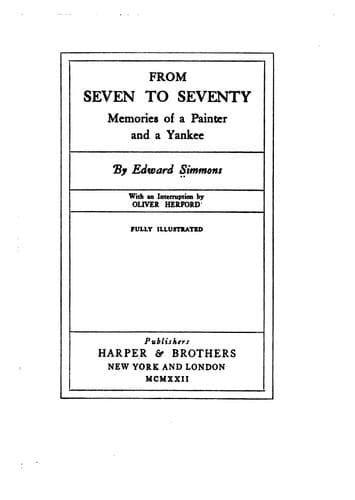
From Seven to Seventy: Memories of a Painter and a YankeeSimmons, Edward
General
From Seven to Seventy: Memories of a Painter and a Yankee
Simmons, Edward
Artists -- Biography
I cannot write a biography, and my opinion is of no value, but Emerson
was one of the supermen I have met. He seemed to glorify everything with
which he came into contact. Like all great men, he was surrounded with a
lot of worshipers, most of them inferiors, and, as Henry James says,
these Concord figures were not so interesting in themselves as that
Emerson thought them so. He was the kind of man who “rendered the
commonplace sacred.”
He was always a teacher or a preacher, whether he remained in the Church
or not. He spoke of Shakespeare as “our man” and Homer as the “old man,”
showing that by training his mind he stood with one mental foot on Homer
and the other, with us, on Shakespeare. He could have been a great
lyricist, but, as Henry Adams remarks, there is no rhythm in New
England; the climate will not permit it. Emerson was ashamed of his love
of beauty, rhythm, and lyricism, as being not quite true to New England.
Like Renan, he blossomed the more fully when surrounded by beautiful
women. He married two. To me he seems a very shrewd Yankee. Look at the
depth of his thought in “Lovers, preserve your strangeness.”
It was because he talked to a great number of his own ilk that he
penetrated America’s thought so easily. I agree with Matthew Arnold that
Emerson was the first essayist of the nineteenth century.
[Illustration:
MARY EMERSON (RIPLEY) SIMMONS
]
The Concord literati are gone, the town has completely changed, but the
Old Manse is still there, holding many secrets. Not the least
interesting of these was uncovered in about ’81, when the house was torn
up to put a bow window in the corner of the southeast parlor. The wall
paper, undoubtedly hideous in color when placed there, had mellowed to a
lovely Whistlerian tone. This, of course, had to be removed. To the
astonishment of everyone, it was discovered that the pattern had been
printed upon the back of French newspapers of the period of the
Revolution. (This economy in paper will be understood by our experience
in the last war.) There were editions with the speeches of Mirabeau and
many other of the patriots of the time. Think of Frank Sanborn, my uncle
George Bradford, and Mr. Emerson, to say nothing of my grandmother
Ripley and John Brown, gathered about the fireplace in this room,
discussing the problems of the Civil War, while from the walls cried out
to them Mirabeau, Robespierre, and Danton:
“_CON-CITOYENS!—CON-CITOYENS!_”
Chapter II: Finding My Wings
_Harvard College_
When I passed the examination for Harvard I had a French turned-up nose,
two spindle legs, and weighed only 114 pounds. Everyone called me a
“barrel on straws,” until I cried myself to sleep night after night for
fear I was going to be a little runt.
I developed very late and very quickly; I did not shave until I was
eighteen years old, yet only one year later I measured six feet in
height and weighed 165 pounds.
Public-domain text, read in full here on John Shaqi.
Reviews
Reviews
No reviews yet
Be the first to share your thoughts on this work.
Join the Discussion
Join the discussion
Sign in to leave a comment or review.
Sign InorCreate an account