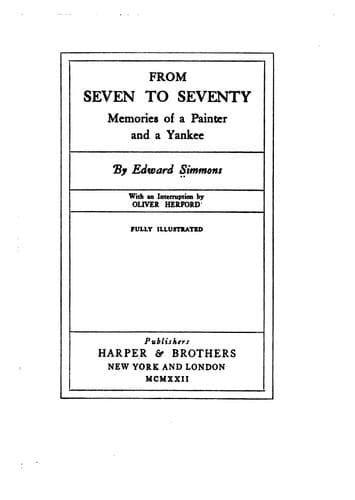
From Seven to Seventy: Memories of a Painter and a YankeeSimmons, Edward
General
From Seven to Seventy: Memories of a Painter and a Yankee
Simmons, Edward
Artists -- Biography
“Of course, that happens only among the lower classes,” replied the
young man, laughing mightily.
Roosevelt then showed all his teeth in a grin and said, “Well, I don’t
think you boys will be asked to meet any lynchers at dinner.”
Literature and the stage meet in The Players, but the stage generally
gets the better of it. Brander Matthews was talking to me once about a
play by him and Bronson Howard that was to open shortly. I asked him
about its possibilities. “Oh,” he said, “if it goes it will be called
another of Bronson’s successes, but if not it will be just another
failure of mine.”
Tarkington was one of the successful writer-playwrights even in those
days. He is one of the few who have borne out their early promise, a man
if there ever was one, with a joy of life that is abounding and a
tremendous interest in his fellow beings, however humble. This natural
curiosity about life and living seems to me a necessity for anyone who
is to do big work in the world. He was modest about his writing. I went
with him to the first night of Richard Mansfield in “Monsieur
Beaucaire.” We were in tweeds and sat up in the “nigger heaven.” On the
stairs I said, “I suppose you dramatized this?”
“Oh no,” he answered, “Mansfield found a coat of mine he liked the looks
of and I cut it over to fit him.”
Tark. thinks so artistically and so cleverly. Here is a quotation from a
letter written to me in 1914. He tells about Arnold Bennett criticizing
the writing of a well-known author as being “too adult,” then goes on to
say:
“Adults make everybody uncomfortable; they want to. Most of the
surprises saved for the startling tags of stories by Guy de Maupassant
and O. Henry are merely little bursts of naturalness—some boyish thing.
We recognize the truth of them at sight—and are surprised for the reason
that a boy or an artist always catches us off our guard.”
There was a galaxy of playwrights, among them Bronson Howard and Clyde
Fitch, now gone as is that dear, kindly, clever man, William Dean
Howells—one ever to be missed. I dined somewhere beside a charming girl,
and the conversation drifted to the usual topic—marriage. I noticed
across the table, just opposite me, the head of Mr. Howells twisting to
right and left and trying to follow our talk, so I said rather
maliciously:
“One of our cleverest writers has said, ‘Man, even after eighteen
hundred years of Christianity, is only imperfectly monogamous.’”
Applause from across the table. “Oh, that is fine, Simmons! Do you
remember who said it?”
“Why, I found it in a book I have just been reading, called _Indian
Summer_.”
He suddenly drew back behind the flowers. “Oh, really!”
A few days afterward a short figure crowded up to me in the elevator of
a large building with an: “Oh, Simmons, I looked that up. I _did_ say
it.”
Public-domain text, read in full here on John Shaqi.
Reviews
Reviews
No reviews yet
Be the first to share your thoughts on this work.
Elsewhere in the archive
Join the Discussion
Join the discussion
Sign in to leave a comment or review.
Sign InorCreate an account