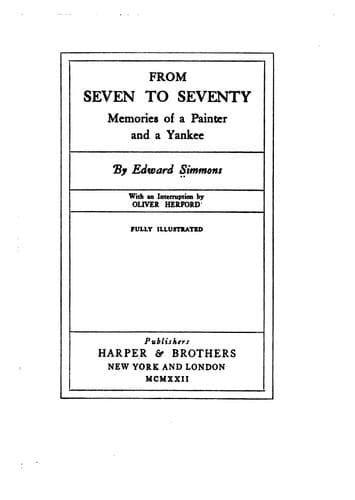
From Seven to Seventy: Memories of a Painter and a YankeeSimmons, Edward
General
From Seven to Seventy: Memories of a Painter and a Yankee
Simmons, Edward
Artists -- Biography
entire stock of freezers; Californians are always eager to pay for their
fun.
Every once in a while there were earthquakes. The small ones were
ignored, but the large ones would send everyone tumbling out of the
buildings onto the sidewalks. It was excitement, and we lived on it.
During the Sunday sermon in one of the churches the building began to
shake, and it is told that the clergyman rose and said:
“Remember that you are in the hands of God here in church as well as
outside....”
At that a piece of plaster fell on the pulpit and he finished:
“But the vestry is good enough for me!”
It was through the store that I met Laura Fair. Hers was a tragic life.
One of those women born to be a companion to men—she was not strong
enough (or was it hard enough) to withstand the buffeting of manmade
laws. Up in Virginia City, where she lived when young, it was said that
“the front of her house always looked like a country funeral,” so many
one-man teams. It was here during the Civil War that she got into her
first trouble. Wrapping herself in the Stars and Bars, she paraded the
streets, daring anyone to stop her; and over her house, which was the
resort of the leading Secessionists, she flew the Confederate flag,
saying she would kill anyone who attempted to lower it. One day a Union
man pulled it down and she shot him dead.
A. P. Crittenden, a lawyer from South Carolina, then championed Mrs.
Fair’s cause, and she was acquitted, due to his passionate and eloquent
appeal at the trial. A close relationship between the two ensued and
they moved to San Francisco, where she was known as the attorney’s
common-law wife. After some years, Crittenden decided to send East for
his legal wife and family. Laura Fair told him directly that she would
kill him if he did. Walking up to the family group as they stood on the
Oakland ferryboat, she quickly drew a revolver from beneath her cloak
and shot him, saying:
“You have ruined the reputation of myself and daughter.”
The state of California has never executed a woman, and, while Mrs. Fair
was sentenced to be hanged at her first trial, at her second one she was
set free. During the ’seventies, she was living quietly, and I had only
vaguely heard her mentioned, when one morning my boss came to the back
of the store, saying:
“You must go out in front and wait on Laura Fair.”
I went out to serve this person, who looked more like an elderly aunt
than a murderess, and I marveled that any man would be afraid of so mild
a creature. She seemed to have no charm whatever.
Public-domain text, read in full here on John Shaqi.
Reviews
Reviews
No reviews yet
Be the first to share your thoughts on this work.
Join the Discussion
Join the discussion
Sign in to leave a comment or review.
Sign InorCreate an account