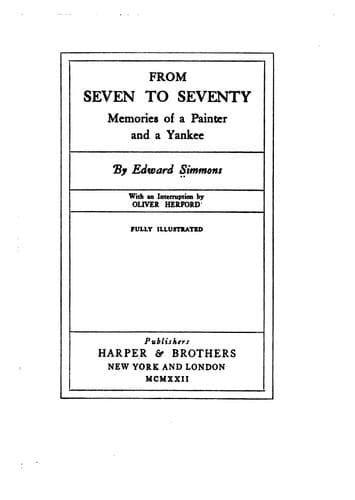
From Seven to Seventy: Memories of a Painter and a YankeeSimmons, Edward
General
From Seven to Seventy: Memories of a Painter and a Yankee
Simmons, Edward
Artists -- Biography
Here in this room I used to dream until most likely interrupted by some
caller upon grandmother. Then I would retire to the corner and listen to
their conversation about antislavery, human freedom, states’ rights,
etc.—understanding not a word, but fascinated by the fervor of the
speakers. I have seen gathered together in this parlor Emerson, Frank
Sanborn, Charles Sumner, and John Brown, the last short and squat, his
great beard upon his breast, and spreading his coat tails before the
fire like a pouter pigeon.
Something that occurred years later, when I was a student at Harvard,
made me appreciate my grandmother more than ever. Prof. Asa Gray, a man
of seventy, and the first botanist of the world at that time, met me in
the Yard one day and stopping me said:
“I understand that your name is Simmons and that you are the grandson of
Mary Bradford Ripley?”
I replied that I was.
He took off his skull cap and bowed low to the ground, saying, “Allow me
to do honor to the offspring of one of the ablest botanists I have ever
known.”
I remember her looks well. Her features were very marked and her nose
big and straight. Her hair was then white and she had blue-gray eyes.
There is a photograph of her sitting under a grape arbor, looking very
absent-minded, with the little finger of her left hand hooked in the
corner of her mouth—a habit of my sister and both of my boys!
Grandfather’s salary as a Unitarian clergyman was the munificent sum of
six hundred dollars a year, and on this my grandmother managed to bring
up a large family of children—doing all the cooking and sewing
herself—marry off three of the girls, and send the two boys through
college. “As big as Sam Ripley” was the saying throughout the
countryside, and, although he was lusty and hail, my grandfather died
when he was in his prime—in fact, before I was born. The circumstances
of his death, which I heard when a youngster, made a deep impression
upon me.
It was the day before Thanksgiving. The Old Manse was full of guests and
relatives when he took his daughter Elizabeth and, filling his buggy
with goodies, drove out to distribute them to his poor parishioners. The
last gift delivered, they turned upon the road home, he remarking that
the Widow Hall would certainly enjoy the two chickens he had left her.
It was a rainy, bleak November night and Lizzie, snuggling into the
robes, almost went to sleep, when, looking down, she noticed the reins
were slipping. She spoke to him, but he did not answer. Even then she
could not realize what the matter was, until, reaching to gather in the
lines, she felt his hand cold beneath hers. He was already dead.
Public-domain text, read in full here on John Shaqi.
Reviews
Reviews
No reviews yet
Be the first to share your thoughts on this work.
Join the Discussion
Join the discussion
Sign in to leave a comment or review.
Sign InorCreate an account