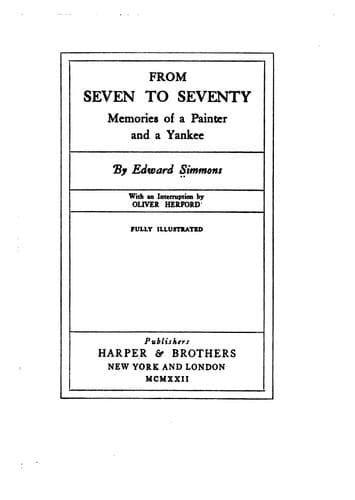
From Seven to Seventy: Memories of a Painter and a YankeeSimmons, Edward
General
From Seven to Seventy: Memories of a Painter and a Yankee
Simmons, Edward
Artists -- Biography
One of my memories of the Old Manse is that of the Thursday-afternoon
visits of Ellery Channing, the poet. I never saw anything written by him
until I left the town. He was always asked to supper and always stayed,
becoming thereby a part of the mental furniture of the place. He was
old, fattish, disorderly, absent-minded, and to me so unæsthetic, that I
_knew_ he could not be a good poet. I don’t believe he was. A humbler
than Thoreau, who practically occupied the same position in the
estimation of the Emersons. I remember with what was then for me horror,
but now extreme sympathy, that years before, his wife had left him
because she had insisted upon his having a carpet in his study. This he
kept patiently removing until, returning from a camping trip, he found
it firmly nailed to the floor; so he pulled it up, tore it in strips,
and hurled it out of the window, thereby ruining the carpet and both
their tempers.
Another frequent caller upon our family was Charles Sumner. I remember
him most vividly upon one occasion. He had come in for luncheon. Mother,
who left the intellectual part of the life to others and always said, “I
find philosophers have just as hearty an appetite as other
people—especially for pie,” was in the kitchen, making this delectable
dish. I was playing upon the sitting-room floor. Suddenly I felt a hand
upon my head.
“My boy,” he said, “when you grow up you’ll find out two things. One is
that all men have mothers, but I don’t think you will ever meet any
other man who has ever had a mother like yours.”
My father died when I was three years old and I had always taken mother
more or less for granted, and I thought him very silly at the time.
I once asked mother how she came to be married. My father, who had
almost been tarred and feathered in the South for his antislavery
sermons, had fled North and finally became the fashionable young
preacher of Boston. Mother was one of five sisters, and said she was
astounded when he asked her to marry him, as she always supposed it was
Lizzie he wanted—Lizzie being the intellectual one. It was that way with
mother. Brought up in an intellectual atmosphere where learning was
considered the only thing of account, she was always surprised when
anyone showed a preference for her—a woman who would rather scrub a
kitchen floor than write an essay!
Mother’s democratic tendencies spread in every direction. There was a
pew in church that was supposed to be reserved for the poor. “No one in
the poorhouse is any poorer than we are,” said mother, and marched us
into it every Sunday. The Old Manse pew was farther up the aisle, and,
besides, one had to pay for that.
Public-domain text, read in full here on John Shaqi.
Reviews
Reviews
No reviews yet
Be the first to share your thoughts on this work.
Join the Discussion
Join the discussion
Sign in to leave a comment or review.
Sign InorCreate an account