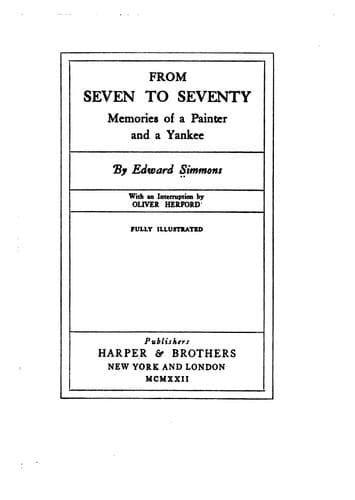
From Seven to Seventy: Memories of a Painter and a YankeeSimmons, Edward
General
From Seven to Seventy: Memories of a Painter and a Yankee
Simmons, Edward
Artists -- Biography
Although she was such a housewife, she had a great independence of
thought. A woman had come to Concord, with no husband, and given birth
to a child. This, for New England at that time, was a terrible scandal.
The boy was my age and went to school. All the other boys whispered
behind his back as if he had been in jail, although by this time his
mother was properly married to a young farmer up on Barret’s Hill. No
one ever spoke to her in church or bowed. My mother, very quietly, every
summer, put on her best clothes and walked the mile or more up the hill
to call.
To me Hawthorne always typified the haughty Southerner. I did not know
what haughty Southerners were like, but I had heard them talked about
and supposed they were very superior creatures—an idea my worthy
relatives would have promptly squelched had they known it. Hawthorne was
a hero to me, and whenever I read a romance, such as _Ivanhoe_ or the
“Iliad,” I pictured the conqueror as tall, broad, dark, and spare, with
a dark mustache. This was the way Hawthorne looked to me.
I would never have dared speak to him, and do not remember having seen
him at the house; but, of course, the Old Manse was filled with memories
of his presence.
I remember staring for hours at a time at the words he wrote on the
window of the dining room, and wondering how he did it. It read:
“On this day my daughter Una was born, while the trees are all glass
chandeliers.”
What a sentence for a boy to dream about! It is still there, and there
are many other windows with his name only.
I had never seen any diamond rings; none of my womenfolk wore rings, and
it seemed strange to me how anyone could write on a pane of glass!
Hawthorne, contrary to public opinion, did not own the Old Manse, but
only rented it from the Ripleys. In fact, he lived there only a year or
more. It was a great disillusion to find later that the grown-ups of my
family did not consider him a great hero, and in fact thought his
writing on the windows a horrible defacement of the house—especially as
they had had some difficulty in collecting the rent.
My most vivid memory of Hawthorne is during the time I was attending the
intermediate school. In front of the building was the town square,
separated from the school by an iron fence. Here we boys used to play
baseball, and upon going home, I, forgetful as always, would invariably
leave behind my dinner pail or my jacket. I was invariably sent back to
fetch it.
Public-domain text, read in full here on John Shaqi.
Reviews
Reviews
No reviews yet
Be the first to share your thoughts on this work.
Join the Discussion
Join the discussion
Sign in to leave a comment or review.
Sign InorCreate an account