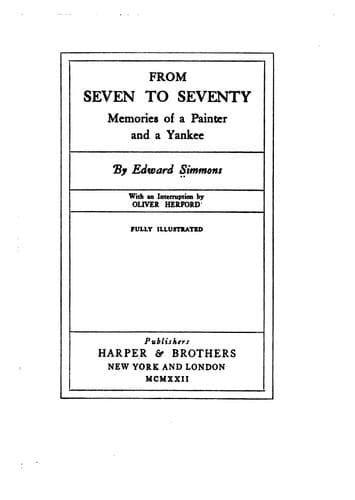
From Seven to Seventy: Memories of a Painter and a YankeeSimmons, Edward
General
From Seven to Seventy: Memories of a Painter and a Yankee
Simmons, Edward
Artists -- Biography
It was very dramatic, the way I first saw Spain. A cold and beastly
night, changing into a hot day; third-class carriage and no coffee; the
first sight out of the car window in the morning a dusty plain. It could
have been an alkali desert in the West. In no sense like the Italians or
French, the Spanish are haughty, silent, laconic, dignified, morose, and
lonely, like their plains with every now and then a brilliant patch of
green. Here and there would be a castle and, clustered around its feet,
tiny houses. Human beings lived there! Farther on, bands of sheep or
goats, and a herder whom one could imagine a Moorish horseman with a
tall spear. There was a Don Quixote at every turn. At last, the plain
stretched and widened until there was a hill line like the horizon of
the ocean. Suddenly, the two horns of a snail stuck up, getting larger
and larger, until the animal seemed to be creeping toward us out of the
distance. A cloudless sky, vast stretches, with no sign of human
habitation anywhere—and the horns of the snail suddenly changed into the
towers of a building—the Cathedral at Bourgos!
At Madrid I saw Titian for the first time; the ones in the Louvre are of
no importance. On one side of a narrow gallery in the Prado will be a
Titian, and on the other side a Velasquez. The former looks five hundred
years old, and the latter very modern, the difference being due,
apparently, to the surface of the canvas; also the movement in my day
was toward Velasquez—the free brush work and the blond note. There is
one marvelous canvas of his here; no one ever did anything like it. He
had painted Phillip, the king, dozens of times, and did the dwarfs and
ladies of the court. Evidently the queen was tired of these, and said to
him one day:
“I want a picture for myself. Do just as I say. Paint my daughter in her
new gown, the fool, dog, and parrot, and the king and myself looking at
you while you do it.”
A large order, but see what he has done! He stands in the center with
his canvas; at one side the infanta, a squat dwarf, and the dog, while
the king and queen are seen at the back in a doorway, with the
background of a garden. Of great value to us is his palette, which he is
holding in his hand, plainly showing what colors he used—red, yellow,
black, and white.
Upon arriving at Elche (from the Roman Illici) under whose walls
Hamilcar Barca, the uncle of Hannibal, died fighting, I realized I had
quietly stepped back four or five hundred years in the history of the
world.
Public-domain text, read in full here on John Shaqi.
Reviews
Reviews
No reviews yet
Be the first to share your thoughts on this work.
Elsewhere in the archive
Join the Discussion
Join the discussion
Sign in to leave a comment or review.
Sign InorCreate an account