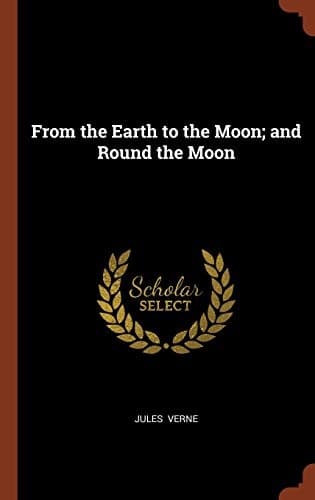
From the Earth to the moon; and, round the moon — John Shaqi
From the Earth to the moon; and, round the moonVerne, Jules
Science
From the Earth to the moon; and, round the moon
Verne, Jules
Manned space flight -- Fiction; Moon -- Fiction; Science fiction; Space flight to the moon -- Fiction; Space ships -- Fiction
“Quite certain,” replied the major. “The Armstrong cannon employs only
seventy-five pounds of powder for a projectile of eight hundred pounds,
and the Rodman Columbiad uses only one hundred and sixty pounds of
powder to send its half ton shot a distance of six miles. These facts
cannot be called in question, for I myself raised the point during the
depositions taken before the committee of artillery.”
“Quite true,” said the general.
“Well,” replied the major, “these figures go to prove that the quantity
of powder is not increased with the weight of the shot; that is to say,
if a 24-pounder shot requires sixteen pounds of powder;—in other words,
if in ordinary guns we employ a quantity of powder equal to two-thirds
of the weight of the projectile, this proportion is not constant.
Calculate, and you will see that in place of three hundred and
thirty-three pounds of powder, the quantity is reduced to no more than
one hundred and sixty pounds.”
“What are you aiming at?” asked the president.
“If you push your theory to extremes, my dear major,” said J. T.
Maston, “you will get to this, that as soon as your shot becomes
sufficiently heavy you will not require any powder at all.”
“Our friend Maston is always at his jokes, even in serious matters,”
cried the major; “but let him make his mind easy, I am going presently
to propose gunpowder enough to satisfy his artillerist’s propensities.
I only keep to statistical facts when I say that, during the war, and
for the very largest guns, the weight of the powder was reduced, as the
result of experience, to a tenth part of the weight of the shot.”
“Perfectly correct,” said Morgan; “but before deciding the quantity of
powder necessary to give the impulse, I think it would be as well—”
“We shall have to employ a large-grained powder,” continued the major;
“its combustion is more rapid than that of the small.”
“No doubt about that,” replied Morgan; “but it is very destructive, and
ends by enlarging the bore of the pieces.”
“Granted; but that which is injurious to a gun destined to perform long
service is not so to our Columbiad. We shall run no danger of an
explosion; and it is necessary that our powder should take fire
instantaneously in order that its mechanical effect may be complete.”
“We must have,” said Maston, “several touch-holes, so as to fire it at
different points at the same time.”
“Certainly,” replied Elphinstone; “but that will render the working of
the piece more difficult. I return then to my large-grained powder,
which removes those difficulties. In his Columbiad charges Rodman
employed a powder as large as chestnuts, made of willow charcoal,
simply dried in cast- iron pans. This powder was hard and glittering,
left no trace upon the hand, contained hydrogen and oxygen in large
proportion, took fire instantaneously, and, though very destructive,
did not sensibly injure the mouth-piece.”
Public-domain text, read in full here on John Shaqi.
Reviews
Reviews
No reviews yet
Be the first to share your thoughts on this work.
Join the Discussion
Join the discussion
Sign in to leave a comment or review.
Sign InorCreate an account