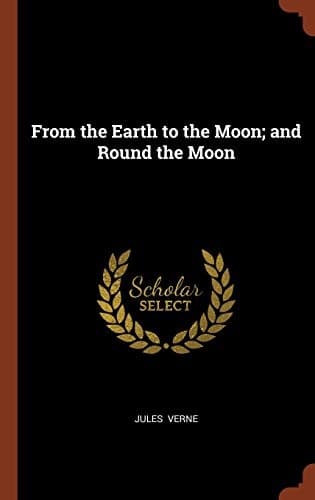
From the Earth to the moon; and, round the moon — John Shaqi
From the Earth to the moon; and, round the moonVerne, Jules
Science
From the Earth to the moon; and, round the moon
Verne, Jules
Manned space flight -- Fiction; Moon -- Fiction; Science fiction; Space flight to the moon -- Fiction; Space ships -- Fiction
Up to this point Barbicane had kept aloof from the discussion; he left
the others to speak while he himself listened; he had evidently got an
idea. He now simply said, “Well, my friends, what quantity of powder do
you propose?”
The three members looked at one another.
“Two hundred thousand pounds.” at last said Morgan.
“Five hundred thousand,” added the major.
“Eight hundred thousand,” screamed Maston.
A moment of silence followed this triple proposal; it was at last
broken by the president.
“Gentlemen,” he quietly said, “I start from this principle, that the
resistance of a gun, constructed under the given conditions, is
unlimited. I shall surprise our friend Maston, then, by stigmatizing
his calculations as timid; and I propose to double his 800,000 pounds
of powder.”
“Sixteen hundred thousand pounds?” shouted Maston, leaping from his
seat.
“Just so.”
“We shall have to come then to my ideal of a cannon half a mile long;
for you see 1,600,000 pounds will occupy a space of about 20,000 cubic
feet; and since the contents of your cannon do not exceed 54,000 cubic
feet, it would be half full; and the bore will not be more than long
enough for the gas to communicate to the projectile sufficient
impulse.”
“Nevertheless,” said the president, “I hold to that quantity of powder.
Now, 1,600,000 pounds of powder will create 6,000,000,000 litres of
gas. Six thousand millions! You quite understand?”
“What is to be done then?” said the general.
“The thing is very simple; we must reduce this enormous quantity of
powder, while preserving to it its mechanical power.”
“Good; but by what means?”
“I am going to tell you,” replied Barbicane quietly.
“Nothing is more easy than to reduce this mass to one quarter of its
bulk. You know that curious cellular matter which constitutes the
elementary tissues of vegetable? This substance is found quite pure in
many bodies, especially in cotton, which is nothing more than the down
of the seeds of the cotton plant. Now cotton, combined with cold nitric
acid, become transformed into a substance eminently insoluble,
combustible, and explosive. It was first discovered in 1832, by
Braconnot, a French chemist, who called it xyloidine. In 1838 another
Frenchman, Pelouze, investigated its different properties, and finally,
in 1846, Schonbein, professor of chemistry at Bale, proposed its
employment for purposes of war. This powder, now called pyroxyle, or
fulminating cotton, is prepared with great facility by simply plunging
cotton for fifteen minutes in nitric acid, then washing it in water,
then drying it, and it is ready for use.”
“Nothing could be more simple,” said Morgan.
“Moreover, pyroxyle is unaltered by moisture—a valuable property to us,
inasmuch as it would take several days to charge the cannon. It ignites
at 170 degrees in place of 240, and its combustion is so rapid that one
may set light to it on the top of the ordinary powder, without the
latter having time to ignite.”
Public-domain text, read in full here on John Shaqi.
Reviews
Reviews
No reviews yet
Be the first to share your thoughts on this work.
Join the Discussion
Join the discussion
Sign in to leave a comment or review.
Sign InorCreate an account