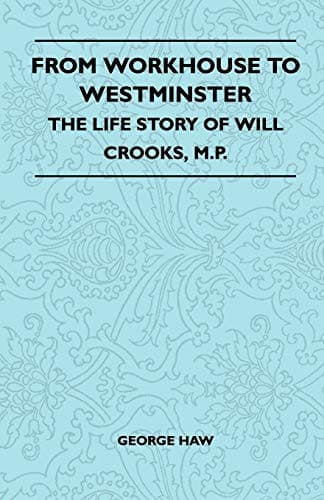
From Workhouse to Westminster: The Life Story of Will Crooks, M.P.Haw, George
History
From Workhouse to Westminster: The Life Story of Will Crooks, M.P.
Haw, George
Crooks, William, 1852-1921; Legislators -- Great Britain -- Biography; Social reformers -- Great Britain -- Biography
Such being the problem, we must reconcile ourselves to finding many of
the Labour Members men of a definite and even pedantic class; men whose
austere and lucid tone, whose elaborate economic explanations smack of
something very different from the actual streets of London. This
economic knowledge may be very necessary. It may remind us of our
duties; but it does not remind us of the Walworth Road. It may enable a
man to speak for the proletarians, but it does not enable a man to speak
with them.
Now, if a man has a good rough-and-ready knowledge of the mechanics of
Battersea and the labourers of Poplar; if the same man has a good
rough-and-ready knowledge of the men in the House of Commons (a vastly
inferior company); he will come out of both those experiences with one
quite square and solid conviction, a conviction the grounds of which,
though they may be difficult to define verbally, are as unshakable as
the ground. He will come out with the conviction that there is really
only one modern Labour Member who represents, who symbolises, or who
even remotely suggests the real labouring men of London; and that is Mr.
Will Crooks.
Mr. Crooks alone fulfils both the functions of the representative. He is
a representative who, like Mr. Keir Hardie and the others, fights,
cleaves a way, does something that only a man of talent could do,
expresses the inexpressible, sacrifices himself. But also, unlike Mr.
Keir Hardie, and the rest, he is a representative who represents. He is
a picture as well as a projectile; he is the stone carved in the image
of Ajax. He is really like the people for whom he stands. A man can
realise this fact, merely as a fact, without implying any disrespect,
for instance, to the Scotch ideality of Mr. Keir Hardie, or the Scotch
strenuousness of Mr. John Burns. They are expressive of the English
democracy, but not typical of it. The first characteristic of Mr.
Crooks, which must strike anyone who has ever had to do with him, even
for ten minutes, is this immense fact of the absolute and isolated
genuineness of his connection with the working classes. To all the other
Labour leaders we listen with respect on Labour matters, because they
have been elected by labourers. To him alone we should listen if he had
never been elected at all. Of him alone it can be said that if we did
not accept him as a representative, we should still accept him as a
type. I need not dwell, and indeed I feel no desire to dwell, on those
qualities in Mr. Crooks which express just now the popular qualities of
the populace. I feel more interest in the unpopular qualities of the
populace.
Public-domain text, read in full here on John Shaqi.
Reviews
Reviews
No reviews yet
Be the first to share your thoughts on this work.
Join the Discussion
Join the discussion
Sign in to leave a comment or review.
Sign InorCreate an account