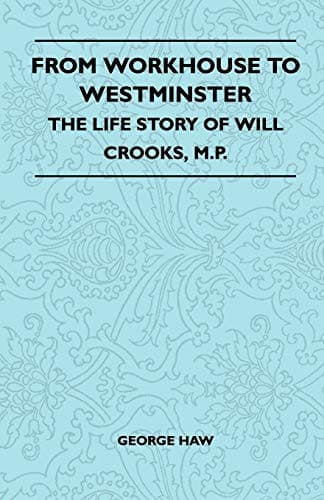
From Workhouse to Westminster: The Life Story of Will Crooks, M.P.Haw, George
History
From Workhouse to Westminster: The Life Story of Will Crooks, M.P.
Haw, George
Crooks, William, 1852-1921; Legislators -- Great Britain -- Biography; Social reformers -- Great Britain -- Biography
In the little one-roomed home where he was born at No. 2, Shirbutt
Street, down by the Docks at Poplar, it was the earnest desire of all
whom it concerned that he should be known to the world as William
Crooks. The desire found practical expression in the register of Trinity
Congregational Church in East India Dock Road close by. Thither, within
a few weeks of his birth, in the year 1852, he was carried with modest
ceremony and solemnly christened by a name which everybody ever since
has refused to give to him.
For somehow "William Crooks" does not sound like the man at all. Looking
at it gives you no suggestion of the good-humoured, hard-headed Labour
man, known as familiarly to his colleagues in the House of Commons as
he is to the great world of wage-earners outside by the shorter and more
expressive name of Will Crooks.
Born in poverty, the third of seven children, Will Crooks, who is
blessed with keen powers of observation and a good memory, can carry his
mind back to the days before he was put into breeches.
"I remember before my fourth year was out," I have heard him tell,
"something of the public rejoicings on the declaration of peace after
the Crimean War. The following year was also memorable to me as the time
I witnessed troops of soldiers marching to the East India Docks on the
outbreak of the Mutiny."
Those were days of want and sorrow, as were many days that followed, in
the little one-roomed home in East London. His father was a ship's
stoker, who lost an arm by the starting of the engines one day when he
was oiling the machinery as his vessel lay in the Thames.
"My very earliest recollections are associated with mother dressing
father's arm day after day. I was only three years old at the time, but
I know that all our privations dated from the day of this accident to my
father, because he was forced to give up his work.
"It must have been with the aid of some good friends that at last my
father got an old horse, hoping to earn a little by leading and carting;
but nothing came of this small venture, and in time the horse had to be
sold to pay the rent. Almost the only work of any kind that father,
being thus disabled, could get to do was an odd job as watchman.
"Those were very lean years indeed, and I don't know what we should have
done but for mother. She used to toil with the needle far into the night
and often all night long, slaving as hard as any poor sweated woman I
have ever known, and I have known hundreds of such poor creatures. Many
a time as a lad have I helped mother to carry the clothes she had made
to Houndsditch. There were no trams running then, and the 'bus fare from
Poplar to Aldgate was fourpence, a sum we never dared think of spending
on a ride.
"My elder brother was as clever with the needle as many a woman, and
often he would stay up all through the night with mother, helping her to
make oil-skin coats."
Public-domain text, read in full here on John Shaqi.
Reviews
Reviews
No reviews yet
Be the first to share your thoughts on this work.
Join the Discussion
Join the discussion
Sign in to leave a comment or review.
Sign InorCreate an account