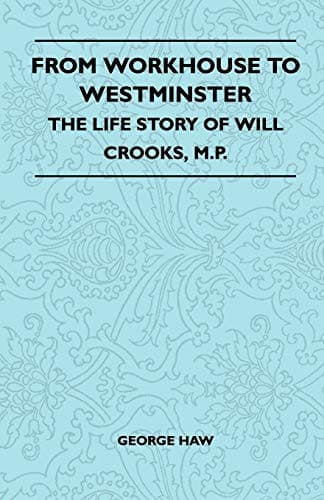
From Workhouse to Westminster: The Life Story of Will Crooks, M.P. — John Shaqi
From Workhouse to Westminster: The Life Story of Will Crooks, M.P.Haw, George
History
From Workhouse to Westminster: The Life Story of Will Crooks, M.P.
Haw, George
Crooks, William, 1852-1921; Legislators -- Great Britain -- Biography; Social reformers -- Great Britain -- Biography
One night, as the mother worked alone, young Will woke up in the little
orange-box bedstead by the wall where he slept with a younger brother.
Silently he watched her plying the needle at the table until he noticed
tears trickling down her cheeks.
"What are you crying for, mother?"
"Never mind, Will, my boy. You go to sleep."
"But you must be crying about something, mother."
And then, in a doleful tone, she said, "It's through wondering where the
next meal is coming from, my boy."
The little chap pretended to go to sleep soon after; but now and again
he would peep cautiously over the side of the box at his mother silently
crying over her work at the table. And he puzzled his young head as to
what it all meant.
"My mother crying because she can't get bread for us! Why can't she get
bread? I saw plenty of bread in the shops yesterday. Do all mothers have
to cry before they can get bread for their children?"
It was the first incident that made him think.
There was one morning, the morning after a Christmas Day of all times in
the year, when his mother refused to let him or the others get up, even
when she left the house. It was not until she returned after what seemed
a long time, bringing with her a portion of a loaf, that she allowed
them to get out of bed.
"It was many years afterwards before I learnt the reason for her strange
conduct that Boxing Day morning. Then I found out that she had made a
vow that her children should never get up unless there was some
breakfast for them.
"We were so poor that we children never got a drop of tea for months
together. It used to be bread and treacle for breakfast, bread and
treacle for dinner, bread and treacle for tea, washed down with a cup of
cold water. Sometimes there was a little variation in the form of
dripping. At other times the variety was secured by there being neither
treacle nor dripping. The very bread was so scarce that mother could not
afford to allow the three eldest, of whom I was one, more than three
slices apiece at a meal, while the four youngest got two and a half
slices. Whenever we could afford to buy tea or butter, it was only in
ounces. Once my brother and I were sent to buy a whole quarter of a
pound of butter--it turned out that auntie was coming to tea--and on the
way we speculated seriously whether mother was going to open a shop."
Perhaps the first occasion upon which Crooks as a lad showed something
of that spirited resentment at aspersions on the poor which ultimately
led him into public life was one that arose in a cobbler's shop. He was
about eight years old, when his father sent him back with a pair of
boots that had been repaired to ask that a little more be done to them
for the money.
"I don't know what he wants for his ninepence," said the cobbler,
referring to the lad's father; "but, there!"--throwing the boots to his
man--"put another patch on. He's only a poor beggar."
Public-domain text, read in full here on John Shaqi.
Reviews
Reviews
No reviews yet
Be the first to share your thoughts on this work.
Join the Discussion
Join the discussion
Sign in to leave a comment or review.
Sign InorCreate an account