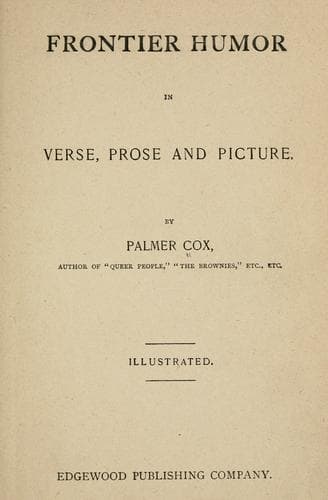
Frontier Humor in Verse, Prose and PictureCox, Palmer
General
Frontier Humor in Verse, Prose and Picture
Cox, Palmer
Canadian wit and humor
This stanza should be introduced into public schools, and adopted as a
morning chant, to impress upon the mind of the pupils the importance of
a person’s having his wits about him. Death brought about by such gross
carelessness as Smith showed, is—to say the least—first cousin to
suicide, and doubtless there will come a time when Smith’s case will be
inquired into.
Under a large oak tree on the south side I came upon a tombstone which
bore no date, but had evidently been erected many years. The fence which
once enclosed the grave had nearly disappeared, nothing remaining except
a few rotten stakes protruding through the grass. What once had been a
mound was now a hollow, which told the mute gazer, decay had done its
worst.
Through a rank growth of weeds and briers, a few pale neglected flowers
raised their delicate faces, like virtue struggling heavenward through
the retarding throng inhabiting this naughty world.
The headstone was evidently erected before the poet’s day, and he who
erected it had composed the epitaph. It is more than likely he chiseled
it also, as the letters were ill-shaped and irregular, and looked as
though carved out with a pick.
Here is a _fac-simile_ of the inscription:—
“Cynthy Ann is berried here.
Be easy with her,
Lord,
And, you won’t lose nothin’,
She was a plaguey good wife to me
But
She wouldn’t be druv.”
That “Cynthia Ann” had faults is evident from the tone. But I thought as
I turned from the spot, if her greatest fault lay in not allowing
herself to be “druv,” her prospects were better than the average.
What a contrast was the line inscribed upon a tombstone directly
opposite:—
“He sleeps in Heaven.”
Mere speculation only, and wild at that. The extravagant notion that a
person sleeps in Paradise must have emanated from the brain of some
sluggard, who thought that heaven without sleep would be a wearisome
place. The “sleeper’s” name was Gregg, and from a representation of a
pair of scissors cut upon the slab I presumed he was a tailor. On making
inquiry of the sexton, busily engaged closing a grave at the time, I
found my supposition was right. Gregg was a tailor, but met death at the
heels of a horse. To use the sexton’s own words, which were spoken in
pure Greek—
“Begorra he _was_ a tailor, and it was meself that planted him there. He
was killed in the barn beyant, while sthrivin’ to pull the makin’s of a
fish-line out of the tail of owld Gleason’s stallion.”
When a person learns what his occupation had been, and how he died, the
assertion that he had gone to heaven, strikes one as too ridiculous for
anything.
[Illustration: THE SEXTON.]
Public-domain text, read in full here on John Shaqi.
Reviews
Reviews
No reviews yet
Be the first to share your thoughts on this work.
Elsewhere in the archive
Join the Discussion
Join the discussion
Sign in to leave a comment or review.
Sign InorCreate an account