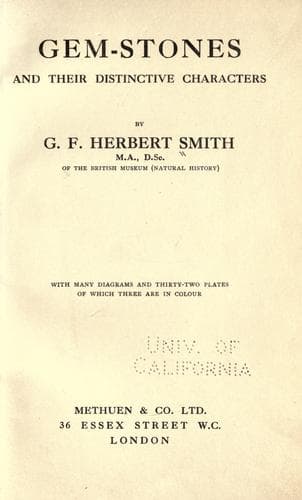
Gem-Stones and Their Distinctive CharactersSmith, George Frederick Herbert
Science
Gem-Stones and Their Distinctive Characters
Smith, George Frederick Herbert
Precious stones
contiguous to the surface, and the colour is due to the resulting
absorption. The apparent darkness of a deep-coloured stone follows from
a different cause: the light passing into the stone is wholly absorbed
within it, and, since none is emitted, the stone appears black. The
claims of turquoise are maintained by the blue variety; there is little
demand for stones of a greenish tinge.
It is evidently desirable that any stones used in jewellery should be
able to resist the mechanical and chemical actions of everyday life. No
one is anxious to replace jewels every few years, and the most valuable
stones are expected to endure for all time. The mechanical abrasion
is caused by the minute grains of sand that are contained in ordinary
dust, and gem-stones should be at least as hard as they—a condition
fulfilled by all the principal species with the exception of opal,
turquoise, peridot, and demantoid. Since the beauty of the first named
does not depend on the brilliancy of its polish, scratches on the
surface are not of much importance; further, all four are only slightly
softer than sand. It may be noted that the softness of paste stones,
apart from any objections that may be felt to the use of imitations,
renders them unsuitable for jewellery purposes. The only stones that
are likely to be chemically affected in the course of wear are those
which are in the slightest degree porous. It is hazardous to immerse
turquoises in liquids, even in water, lest the bluish green colour be
oxidized to the despised yellowish hue. The risk of damage to opals,
moonstones, and star-stones by the penetration of dirt or grease into
the interior of the stones is less, but is not wholly negligible.
Similar remarks apply with even greater force to pearls. Their charm,
which is due to a peculiar surface-play of light, might be destroyed by
contamination with grease, ink, or similar matter; they are, moreover,
soft. For both reasons their use in rings is much to be deprecated.
Nothing can be more unsightly than the dingy appearance of a pearl ring
after a few years’ wear.
It cannot be gainsaid that mankind prefers the rare to the beautiful,
and what is within reach of all is lightly esteemed. It is for this
reason that garnet and moonstone lie under a cloud. Purchasers can
readily be found for a ‘Cape-ruby’ or an ‘olivine,’ but not for a
garnet; garnets are so common, is the usual remark. Nevertheless,
the stones mentioned are really garnets. If science succeeded in
manufacturing diamonds at the cost of shillings instead of the pounds
that are now asked for Nature’s products—not that such a prospect is at
all probable or even feasible—we might expect them to vanish entirely
from fashionable jewellery.
Public-domain text, read in full here on John Shaqi.
Reviews
Reviews
No reviews yet
Be the first to share your thoughts on this work.
Join the Discussion
Join the discussion
Sign in to leave a comment or review.
Sign InorCreate an account