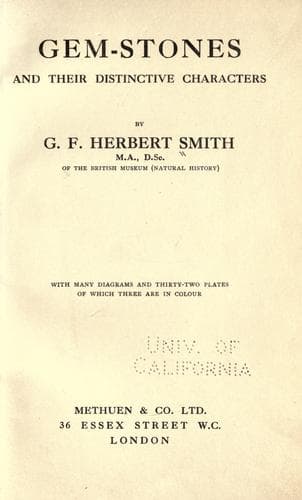
Gem-Stones and Their Distinctive Characters — John Shaqi
Gem-Stones and Their Distinctive CharactersSmith, George Frederick Herbert
Science
Gem-Stones and Their Distinctive Characters
Smith, George Frederick Herbert
Precious stones
A careful study of the showcases of the most extensive jewellery
establishment brings to light the fact that, despite the apparent
profusion, the number of different species represented is restricted.
Diamond, ruby, emerald, sapphire, pearl, opal, turquoise, topaz,
amethyst are all that are ordinarily asked for. Yet, as later pages
will show, there are many others worthy of consideration; two among
them—peridot and tourmaline—are, indeed, slowly becoming known. For
the first five of the stones mentioned above, the demand is relatively
steady, and varies absolutely only with the purchasing power of the
world; but a lesser known stone may suddenly spring into prominence
owing to the caprice of fashion or the preference of some great lady
or leader of fashion. Not many years ago, for instance, violet was the
favourite colour for ladies’ dresses, and consequently amethysts were
much worn to match, but with the change of fashion they speedily sank
to their former obscurity. Another stone may perhaps figure at some
royal wedding; for a brief while it becomes the vogue, and afterwards
is seldom seen.
Except that diamond, ruby, emerald, and sapphire, and, we should add,
pearl, may indisputably be considered to occupy the first rank, it is
impossible to form the gem-stones in any strict order. Every generation
sees some change. The value of a stone is after all merely what it will
fetch in the open market, and its artistic merits may be a matter of
opinion. The familiar aphorism, _de gustibus non est disputandum_, is a
warning not to enlarge upon this point.
PART I—SECTION A
THE CHARACTERS OF GEM-STONES
CHAPTER II
CRYSTALLINE FORM
With the single exception of opal, the whole of the principal mineral
species used in jewellery are distinguished from glass and similar
substances by one fundamental difference: they are crystallized matter,
and the atoms composing them are regularly arranged throughout the
structure.
Public-domain text, read in full here on John Shaqi.
Reviews
Reviews
No reviews yet
Be the first to share your thoughts on this work.
Join the Discussion
Join the discussion
Sign in to leave a comment or review.
Sign InorCreate an account