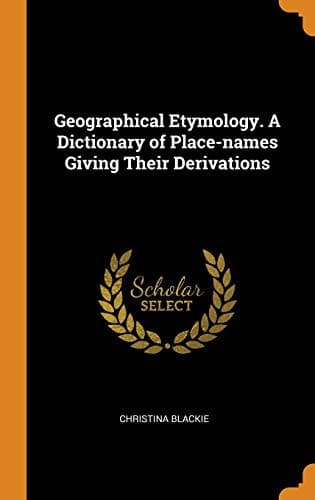
Geographical etymology: a dictionary of place-names giving their derivationsBlackie, Christina
History
Geographical etymology: a dictionary of place-names giving their derivations
Blackie, Christina
Names, Geographical
[Sidenote: ORT (Ger.),
OORT (Dutch),
ORD (Scand.),]
a point, a corner, and sometimes a place; _e.g._ Angerort (the corner
of the R. Anger); Ruhrort (of the Rohr or Ruhr); Grünort (green point);
Schönort (beautiful point); Akkerort (the corner of the field);
Tiegenort (of the R. Tiege); Störort (of the R. Stör); the Ord or
headland of Caithness.
[Sidenote: OST, OEST (Ger.),
OOST (Dutch),
OSTER (Scand.),]
the east; _e.g._ Ostend (at the east end or opening of the canal into
the ocean); Osterburg, Osterfeld, Osterhofen (the east town, field,
and court); Osterholtz (the east wood); Osterdalen (the east basin of
the R. Duhl), in Sweden; Ostheim, Osthausen, Oesthammer (the eastern
dwelling or village); Ostwald (east wood), in Alsace; Essex (the
country of the East Saxons, in opposition to Wessex); Austerlitz (the
east town of the R. Littawa); Alost (to the east), in Belgium.
[Sidenote: OSTROW, or OZERO (Sclav.),]
an island or lake; _e.g._ Ostrov, in Russia (on a river-island);
Kolkoe-Ostrog (the island in the R. Kola); Ostrova (an island in the
Danube); Bielo-Ozero (the white lake); Tschudskoe-Ozero (the lake of
the Tschudes, a tribe); Ostrownoye (the new island). But Ostrow and
Wustrow are sometimes Germanised forms of _Wotschow_, Sclav, (a marshy
place), as in Wustrow, Ostropol, Ostrasatz, Ostrawiec (the place on the
marshy ground).
[Sidenote: OTERO (Span.),]
a hill or rising ground; _e.g._ El-Otero (the rising ground);
Otero-de-las-duenas (the hill of the old ladies); Otero-del-Rey (the
king’s hill).
[Sidenote: OW, ITZ, OWIZ, OO,]
Sclavonic affixes, used as patronymics, like the Ger. _ingen_; _e.g._
Nowakwitz (the possession of the descendants of Nouak); Jvanow, Janow,
Janowitz (belonging to John and his descendants); Karlowitz (to
Charles); Petrowitz (to Peter); Kazimiritz (to Casimir); Mitrowitz (to
Demetrius); Stanislowow (to Stanislaus); Tomazow (to Thomas); Cracow
or Kracow (the town of Duke Craus or Krak of Poland, by whom it was
founded in 1700).
P
[Sidenote: PALATIUM (Lat.),
PALAZZO (It.),
PALACHIO (Span.),
PALAS (Cym.-Cel.),
PAILIS (Gadhelic),]
a palace; _e.g._ the Upper and Lower Palatinate, so called from the
palaces erected by the Roman emperors in different parts of the
empire; Palazzo, in Dalmatia and Naples; Palazzolo and Palazzuolo (the
great palace), in Piedmont; Los Palachios (the palaces), in Spain;
Pfalsbourg, anc. _Palatiolum_ (the town of the palace, founded in
1570), in France; Semipalatinsk, in Siberia (the town of the seven
palaces), so called from the extensive ruins in its neighbourhood;
Spalatro, in Dalmatia, named from the palace of Diocletian, originally
_Salonæ-Palatium_ (the palace near Salona), at first corrupted to
_As-palthium_ (at the palace), and then to Spalatro. In Wales:
Plas-gwyn (the white palace); Plas-newydd (the new palace).
[Sidenote: PALLI (Tamil),]
Public-domain text, read in full here on John Shaqi.
Reviews
Reviews
No reviews yet
Be the first to share your thoughts on this work.
Elsewhere in the archive
Join the Discussion
Join the discussion
Sign in to leave a comment or review.
Sign InorCreate an account