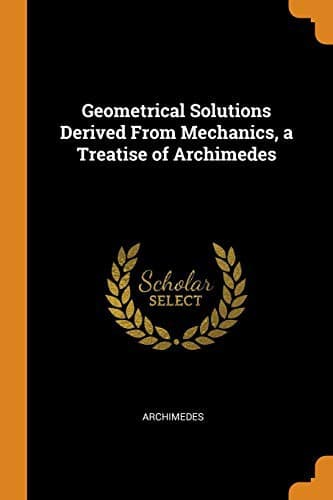
Geometrical Solutions Derived from Mechanics; a Treatise of ArchimedesArchimedes
History
Geometrical Solutions Derived from Mechanics; a Treatise of Archimedes
Archimedes
Geometry -- Early works to 1800
$\epsilon\zeta$ and whose vertex is at $\alpha$ and let $\alpha\eta$
be so divided at $\phi$ that $\alpha\eta = 4\phi\eta$; then $\phi$ is
the center of gravity of the cone $\epsilon\alpha\zeta$ as has been
previously proved. Moreover let the cylinder $\mu\nu$ be so cut by a
perpendicularly intersecting plane that the cylinder $\mu$ is in
equilibrium with the cone $\epsilon\alpha\zeta$. Now since the segment
$\alpha\beta\delta$ + the cone $\epsilon\alpha\zeta$ in their present
positions are in equilibrium at $\alpha$ with the cone
$\epsilon\alpha\zeta$ if it is transferred and so arranged on the
scale-beam at $\theta$ that $\theta$ is its center of gravity, and
cylinder $\mu\nu$ = cone $\epsilon\alpha\zeta$ and the two cylinders
$\mu + \nu$ are moved to $\theta$ and $\mu\nu$ is in equilibrium with
both bodies, then will also the cylinder $\nu$ be in equilibrium with
the segment of the sphere at the point $\alpha$. And since the
spherical segment $\beta\alpha\delta$ : the cone whose base is the
circle with the diameter $\beta\delta$, and whose vertex is at $\alpha
= \xi\eta : \eta\gamma$ (for this has previously been proved [\emph{De
sph. et cyl.} II, 2 Coroll.]) and cone $\beta\alpha\delta$ : cone
$\epsilon\alpha\zeta$ = the circle with the diameter $\beta\delta$ :
the circle with the diameter $\epsilon\zeta = \beta\eta^2 :
\eta\epsilon^2$, and $\beta\eta^2 = \gamma\eta \times \eta\alpha$,
$\eta\epsilon^2 = \eta\alpha^2$, and $\gamma\eta \times \eta\alpha :
\eta\alpha^2 = \gamma\eta : \eta\alpha$, therefore cone
$\beta\alpha\delta$ : cone $\epsilon\alpha\zeta = \gamma\eta :
\eta\alpha$. But we have shown that cone $\beta\alpha\delta$ :
segment $\beta\alpha\delta$ = $\gamma\eta : \eta\xi$, hence
{\selectlanguage{greek}di' \~isou} segment $\beta\alpha\delta$ : cone
$\epsilon\alpha\zeta$ = $\xi\eta : \eta\alpha$. And because
$\alpha\chi : \chi\eta = \eta\alpha + 4\eta\gamma : \alpha\eta +
2\eta\gamma$ so inversely $\eta\chi : \chi\alpha = 2\gamma\eta +
\eta\alpha : 4\gamma\eta + \eta\alpha$ and by addition $\eta\alpha :
\alpha\chi = 6\gamma\eta + 2\eta\alpha : \eta\alpha +
4\eta\gamma$. But $\eta\xi = \frac{1}{4} (6\eta\gamma + 2\eta\alpha)$
and $\gamma\phi = \frac{1}{4} (4\eta\gamma + \eta\alpha)$; for that is
evident. Hence $\eta\alpha : \alpha\chi = \xi\eta : \gamma\phi$,
consequently also $\xi\eta : \eta\alpha = \gamma\phi : \chi\alpha$.
But it was also demonstrated that $\xi\eta : \eta\alpha$ = the segment
whose vertex is at $\alpha$ and whose base is the circle with the
diameter $\beta\delta$ : the cone whose vertex is at $\alpha$ and
whose base is the circle with the diameter $\epsilon\zeta$; hence
segment $\beta\alpha\delta$ : cone $\epsilon\alpha\zeta$ = $\gamma\phi
: \chi\alpha$. And since the cylinder $\mu$ is in equilibrium with the
cone $\epsilon\alpha\zeta$ at $\alpha$, and $\theta$ is the center of
gravity of the cylinder while $\phi$ is that of the cone
$\epsilon\alpha\zeta$, then cone $\epsilon\alpha\zeta$ : cylinder
Public-domain text, read in full here on John Shaqi.
Reviews
Reviews
No reviews yet
Be the first to share your thoughts on this work.
Join the Discussion
Join the discussion
Sign in to leave a comment or review.
Sign InorCreate an account