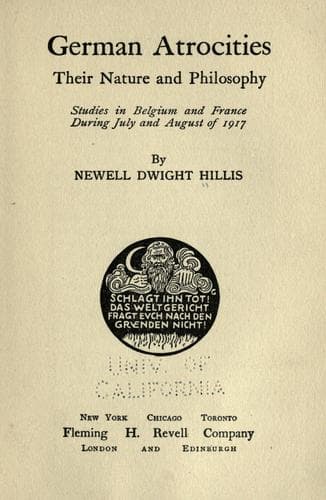
German Atrocities: Their Nature and PhilosophyHillis, Newell Dwight
History
German Atrocities: Their Nature and Philosophy
Hillis, Newell Dwight
Pangermanism; World War, 1914-1918; World War, 1914-1918 -- Atrocities
German apostasy began with German military success. What the Kaiser
offered to Germany in exchange for her soul was the Pan-German empire.
The originator of the world empire scheme was the Kaiser; Nietzsche
was its philosopher; Treitsche its historian; Bernhardi its advocate;
and von Hindenburg its executive. The first conference regarding the
Pan-German empire seems to have been called in 1895, and was held
in the Potsdam Palace. During the next two or three years, a world
organization was brought together by the "Potsdam gang," with the
Kaiser at the center, an inner circle of officers, and politicians,
a larger circle of bankers, manufacturers, and ship owners. Finally
there was a far-flung web of diplomats, spies, commercial travellers,
Pan-German League agents, organizing in New York, Chicago and San
Francisco, in Buenos Ayres and Rio de Janeiro, in Buda Pesth and
Vienna, in Constantinople and Cairo, German Veteran Leagues, German
Commercial Associations, all looking towards the day when the Kaiser
would be the world emperor, and all countries would become provinces
paying tribute to the world capital, Berlin. "What about international
law?" asked an American diplomat of Bernhardi. "There will be no
international law," was the answer. "Berlin will decide what laws are
best for the rest of the world."
The Pan-German empire pamphlets, maps, books, magazine articles,
published during the next ten years, were legion, but Professor
Tannemann, a personal friend of the Kaiser, in 1911 restated the
Kaiser's scheme. The essence of Pan-German plan was condensed into a
few sentences: "From Hamburg and the North Sea to the Persian Gulf;
the immediate goal, by 1915, the conquest of 250,000,000 of people;
the ultimate goal, the Germanization of all the nations of the world."
One of the Kaiser's speeches contains the explanation of his dream
of becoming a world conqueror: "From my childhood I have been under
the influence of five men,--Alexander, Julius Cæsar, Theodoric II,
Frederick the Great and Napoleon. Each of these men dreamed a dream
of a world empire; they failed. I am dreaming a dream of a German
world empire--and my mailed fist shall succeed." The Kaiser printed
a map headed, "The Roman Empire; Cæsar Augustus, world emperor."
That map shows the once great states, Athens, Ephesus, Jerusalem,
Alexandria, Carthage, reduced to county seat towns, paying tribute to
the world capital, while their captive kings had walked as slaves in
the triumphal processions along the Appian Way, towards the palace
of the world ruler, Cæsar Augustus. One of the Pan-German empire
pamphlets, and many of the German newspapers contain a revised map
of Europe, showing "Germania" stamped across the continent, with St.
Petersburg, Paris and London become county seat towns, paying tribute
to the world capital, Berlin. Many German newspapers, during this
war, have published maps showing Canada as a German province, with
Public-domain text, read in full here on John Shaqi.
Reviews
Reviews
No reviews yet
Be the first to share your thoughts on this work.
Join the Discussion
Join the discussion
Sign in to leave a comment or review.
Sign InorCreate an account