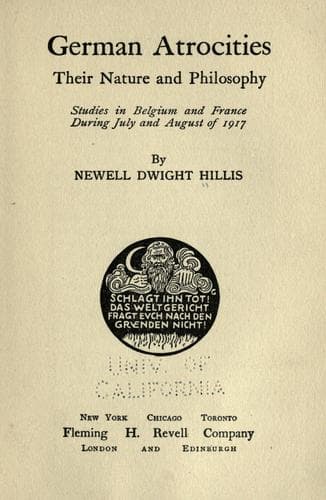
German Atrocities: Their Nature and PhilosophyHillis, Newell Dwight
History
German Atrocities: Their Nature and Philosophy
Hillis, Newell Dwight
Pangermanism; World War, 1914-1918; World War, 1914-1918 -- Atrocities
the name "Germania" stamped across South America, Mexico and Central
America. These many pamphlets and Pan-German empire books explain
Admiral Dewey's report to President McKinley. That report seems to have
been written in the cabin of the flag-ship _Olympia_, in Manila Bay.
Dewey states that the German admiral told him plainly to make a note
of this prophecy that within fifteen years (1899, report of Admiral
Dewey), Germany would crush France and Belgium, seize Holland and
Denmark, utterly destroy England, and take Canada as a German province.
Admiral Dewey added that the German admiral told him that while the
Kaiser intended to seize New York and Washington and hold them for an
indemnity, he did not intend to permanently hold in subjection the
United States, but he did intend to retain Mexico and South America,
and then "dispose of the Monroe Doctrine as he thinks best." This may
explain the Kaiser's word to Mr. Gerard: "After this war I will stand
no nonsense from the United States." So astounding were these claims
that the statesmen and rulers of the world laughed at these threats,
deeming it incredible that Germany was plotting a world war. Two or
three men of remarkable prescience and vision, General Roberts in
London, Chéradame in Paris, and Ex-President Roosevelt, understood and
therefore never ceased warning the nation to prepare and make ready for
a conflict that seemed to them inevitable.
When the Kaiser first announced his Pan-German empire scheme he bribed
his people by appeals to avarice, ambition, and jealousy of England
and Russia. The arguments used by the Potsdam gang were very simple:
Agriculture pays six per cent., trade eight per cent., finance ten per
cent., shipping twelve per cent., but war is an industry that pays
fifty per cent. dividend upon the investment. Germany's war upon little
Denmark, a people without army or navy, paid an enormous dividend upon
the investment, in that it gave Germany one of her richest provinces,
made possible the Kiel Canal, and left Denmark permanently crippled
and exposed. "Denmark and Holland, also, are apples," says a German
author, "that are slowly ripening, and we will pick the fruit at the
proper time." Germany's war of 1864 upon Austria was the attack of a
brigand upon a traveller rich with gold, and the cities and provinces
that Germany wrested away from the ruler of Vienna paid a hundred per
cent. upon the investment. In his Memoirs Bismarck tells the world
plainly that he deliberately fomented a war with France, that he might
seize the iron ore provinces of Alsace and Lorraine, in order to obtain
the hematite iron that would make it possible for Germany to pass from
the agricultural people into an industrial and manufacturing state as
the competitor of England for the world's trade. For more than forty
years the chief argument presented in the Reichstag for increased
appropriations for the army and the navy was the money dividends paid
by war.
Public-domain text, read in full here on John Shaqi.
Reviews
Reviews
No reviews yet
Be the first to share your thoughts on this work.
Join the Discussion
Join the discussion
Sign in to leave a comment or review.
Sign InorCreate an account