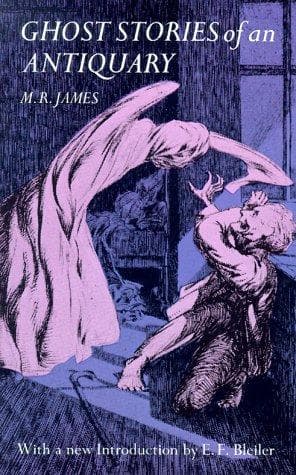
Ghost Stories of an AntiquaryJames, M. R. (Montague Rhodes)
General
Ghost Stories of an Antiquary
James, M. R. (Montague Rhodes)
Ghost stories, English; Horror tales, English; Short stories, English
So it was. First, at the fork, they saw a round body covered with
fire—the size of a man’s head—appear very suddenly, then seem to
collapse and fall back. This, five or six times; then a similar ball
leapt into the air and fell on the grass, where after a moment it lay
still. The Bishop went as near as he dared to it, and saw—what but the
remains of an enormous spider, veinous and seared! And, as the fire
burned lower down, more terrible bodies like this began to break out
from the trunk, and it was seen that these were covered with greyish
hair.
All that day the ash burned, and until it fell to pieces the men stood
about it, and from time to time killed the brutes as they darted out.
At last there was a long interval when none appeared, and they
cautiously closed in and examined the roots of the tree.
“They found,” says the Bishop of Kilmore, “below it a rounded hollow
place in the earth, wherein were two or three bodies of these creatures
that had plainly been smothered by the smoke; and, what is to me more
curious, at the side of this den, against the wall, was crouching the
anatomy or skeleton of a human being, with the skin dried upon the
bones, having some remains of black hair, which was pronounced by those
that examined it to be undoubtedly the body of a woman, and clearly
dead for a period of fifty years.”
NUMBER 13
Among the towns of Jutland, Viborg justly holds a high place. It is the
seat of a bishopric; it has a handsome but almost entirely new
cathedral, a charming garden, a lake of great beauty, and many storks.
Near it is Hald, accounted one of the prettiest things in Denmark; and
hard by is Finderup, where Marsk Stig murdered King Erik Glipping on St
Cecilia’s Day, in the year 1286. Fifty-six blows of square-headed iron
maces were traced on Erik’s skull when his tomb was opened in the
seventeenth century. But I am not writing a guide-book.
There are good hotels in Viborg—Preisler’s and the Phœnix are all that
can be desired. But my cousin, whose experiences I have to tell you
now, went to the Golden Lion the first time that he visited Viborg. He
has not been there since, and the following pages will, perhaps,
explain the reason of his abstention.
The Golden Lion is one of the very few houses in the town that were not
destroyed in the great fire of 1726, which practically demolished the
cathedral, the Sognekirke, the Raadhuus, and so much else that was old
and interesting. It is a great red-brick house—that is, the front is of
brick, with corbie steps on the gables and a text over the door; but
the courtyard into which the omnibus drives is of black and white wood
and plaster.
The sun was declining in the heavens when my cousin walked up to the
door, and the light smote full upon the imposing façade of the house.
He was delighted with the old-fashioned aspect of the place, and
promised himself a thoroughly satisfactory and amusing stay in an inn
so typical of old Jutland.
Public-domain text, read in full here on John Shaqi.
Reviews
Reviews
No reviews yet
Be the first to share your thoughts on this work.
Join the Discussion
Join the discussion
Sign in to leave a comment or review.
Sign InorCreate an account