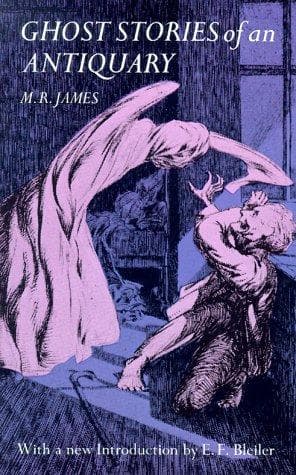
Ghost Stories of an AntiquaryJames, M. R. (Montague Rhodes)
General
Ghost Stories of an Antiquary
James, M. R. (Montague Rhodes)
Ghost stories, English; Horror tales, English; Short stories, English
It was not business in the ordinary sense of the word that had brought
Mr Anderson to Viborg. He was engaged upon some researches into the
Church history of Denmark, and it had come to his knowledge that in the
Rigsarkiv of Viborg there were papers, saved from the fire, relating to
the last days of Roman Catholicism in the country. He proposed,
therefore, to spend a considerable time—perhaps as much as a fortnight
or three weeks—in examining and copying these, and he hoped that the
Golden Lion would be able to give him a room of sufficient size to
serve alike as a bedroom and a study. His wishes were explained to the
landlord, and, after a certain amount of thought, the latter suggested
that perhaps it might be the best way for the gentleman to look at one
or two of the larger rooms and pick one for himself. It seemed a good
idea.
The top floor was soon rejected as entailing too much getting upstairs
after the day’s work; the second floor contained no room of exactly the
dimensions required; but on the first floor there was a choice of two
or three rooms which would, so far as size went, suit admirably.
The landlord was strongly in favour of Number 17, but Mr Anderson
pointed out that its windows commanded only the blank wall of the next
house, and that it would be very dark in the afternoon. Either Number
12 or Number 14 would be better, for both of them looked on the street,
and the bright evening light and the pretty view would more than
compensate him for the additional amount of noise.
Eventually Number 12 was selected. Like its neighbours, it had three
windows, all on one side of the room; it was fairly high and unusually
long. There was, of course, no fireplace, but the stove was handsome
and rather old—a cast-iron erection, on the side of which was a
representation of Abraham sacrificing Isaac, and the inscription, “1
Bog Mose, Cap. 22,” above. Nothing else in the room was remarkable; the
only interesting picture was an old coloured print of the town, date
about 1820.
Public-domain text, read in full here on John Shaqi.
Reviews
Reviews
No reviews yet
Be the first to share your thoughts on this work.
Join the Discussion
Join the discussion
Sign in to leave a comment or review.
Sign InorCreate an account