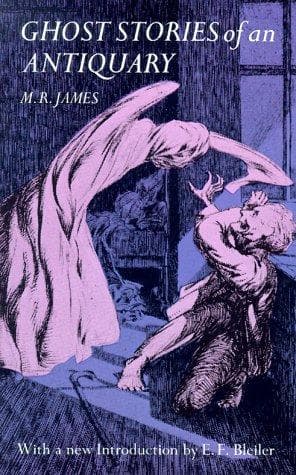
Ghost Stories of an AntiquaryJames, M. R. (Montague Rhodes)
General
Ghost Stories of an Antiquary
James, M. R. (Montague Rhodes)
Ghost stories, English; Horror tales, English; Short stories, English
At once all Dennistoun’s cherished dreams of finding priceless
manuscripts in untrodden corners of France flashed up, to die down
again the next moment. It was probably a stupid missal of Plantin’s
printing, about 1580. Where was the likelihood that a place so near
Toulouse would not have been ransacked long ago by collectors? However,
it would be foolish not to go; he would reproach himself for ever after
if he refused. So they set off. On the way the curious irresolution and
sudden determination of the sacristan recurred to Dennistoun, and he
wondered in a shamefaced way whether he was being decoyed into some
purlieu to be made away with as a supposed rich Englishman. He
contrived, therefore, to begin talking with his guide, and to drag in,
in a rather clumsy fashion, the fact that he expected two friends to
join him early the next morning. To his surprise, the announcement
seemed to relieve the sacristan at once of some of the anxiety that
oppressed him.
“That is well,” he said quite brightly—“that is very well. Monsieur
will travel in company with his friends; they will be always near him.
It is a good thing to travel thus in company—sometimes.”
The last word appeared to be added as an afterthought and to bring with
it a relapse into gloom for the poor little man.
They were soon at the house, which was one rather larger than its
neighbours, stone-built, with a shield carved over the door, the shield
of Alberic de Mauléon, a collateral descendant, Dennistoun tells me, of
Bishop John de Mauléon. This Alberic was a Canon of Comminges from 1680
to 1701. The upper windows of the mansion were boarded up, and the
whole place bore, as does the rest of Comminges, the aspect of decaying
age.
Arrived on his doorstep, the sacristan paused a moment.
“Perhaps,” he said, “perhaps, after all, monsieur has not the time?”
“Not at all—lots of time—nothing to do till tomorrow. Let us see what
it is you have got.”
The door was opened at this point, and a face looked out, a face far
younger than the sacristan’s, but bearing something of the same
distressing look: only here it seemed to be the mark, not so much of
fear for personal safety as of acute anxiety on behalf of another.
Plainly, the owner of the face was the sacristan’s daughter; and, but
for the expression I have described, she was a handsome girl enough.
She brightened up considerably on seeing her father accompanied by an
able-bodied stranger. A few remarks passed between father and daughter,
of which Dennistoun only caught these words, said by the sacristan, “He
was laughing in the church,” words which were answered only by a look
of terror from the girl.
Public-domain text, read in full here on John Shaqi.
Reviews
Reviews
No reviews yet
Be the first to share your thoughts on this work.
Join the Discussion
Join the discussion
Sign in to leave a comment or review.
Sign InorCreate an account