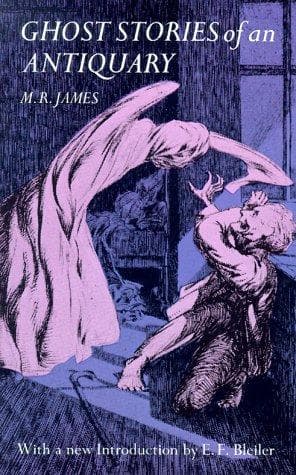
Ghost Stories of an AntiquaryJames, M. R. (Montague Rhodes)
General
Ghost Stories of an Antiquary
James, M. R. (Montague Rhodes)
Ghost stories, English; Horror tales, English; Short stories, English
But in another minute they were in the sitting-room of the house, a
small, high chamber with a stone floor, full of moving shadows cast by
a wood-fire that flickered on a great hearth. Something of the
character of an oratory was imparted to it by a tall crucifix, which
reached almost to the ceiling on one side; the figure was painted of
the natural colours, the cross was black. Under this stood a chest of
some age and solidity, and when a lamp had been brought, and chairs
set, the sacristan went to this chest, and produced therefrom, with
growing excitement and nervousness, as Dennistoun thought, a large
book, wrapped in a white cloth, on which cloth a cross was rudely
embroidered in red thread. Even before the wrapping had been removed,
Dennistoun began to be interested by the size and shape of the volume.
“Too large for a missal,” he thought, “and not the shape of an
antiphoner; perhaps it may be something good, after all.” The next
moment the book was open, and Dennistoun felt that he had at last lit
upon something better than good. Before him lay a large folio, bound,
perhaps, late in the seventeenth century, with the arms of Canon
Alberic de Mauléon stamped in gold on the sides. There may have been a
hundred and fifty leaves of paper in the book, and on almost every one
of them was fastened a leaf from an illuminated manuscript. Such a
collection Dennistoun had hardly dreamed of in his wildest moments.
Here were ten leaves from a copy of Genesis, illustrated with pictures,
which could not be later than A.D. 700. Further on was a complete set
of pictures from a Psalter, of English execution, of the very finest
kind that the thirteenth century could produce; and, perhaps best of
all, there were twenty leaves of uncial writing in Latin, which, as a
few words seen here and there told him at once, must belong to some
very early unknown patristic treatise. Could it possibly be a fragment
of the copy of Papias “On the Words of Our Lord”, which was known to
have existed as late as the twelfth century at Nîmes?[1] In any case,
his mind was made up; that book must return to Cambridge with him, even
if he had to draw the whole of his balance from the bank and stay at
St. Bertrand till the money came. He glanced up at the sacristan to see
if his face yielded any hint that the book was for sale. The sacristan
was pale, and his lips were working.
[1] We now know that these leaves did contain a considerable fragment
of that work, if not of that actual copy of it.
“If monsieur will turn on to the end,” he said.
Public-domain text, read in full here on John Shaqi.
Reviews
Reviews
No reviews yet
Be the first to share your thoughts on this work.
Join the Discussion
Join the discussion
Sign in to leave a comment or review.
Sign InorCreate an account