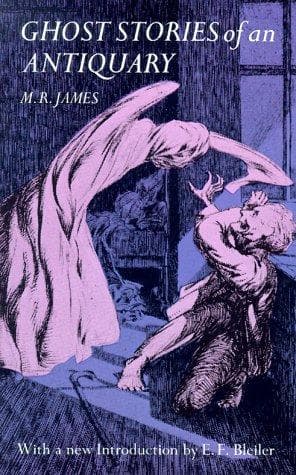
Ghost Stories of an AntiquaryJames, M. R. (Montague Rhodes)
General
Ghost Stories of an Antiquary
James, M. R. (Montague Rhodes)
Ghost stories, English; Horror tales, English; Short stories, English
which this figure makes upon anyone who looks at it. I recollect once
showing the photograph of the drawing to a lecturer on morphology—a
person of, I was going to say, abnormally sane and unimaginative habits
of mind. He absolutely refused to be alone for the rest of that
evening, and he told me afterwards that for many nights he had not
dared to put out his light before going to sleep. However, the main
traits of the figure I can at least indicate. At first you saw only a
mass of coarse, matted black hair; presently it was seen that this
covered a body of fearful thinness, almost a skeleton, but with the
muscles standing out like wires. The hands were of a dusky pallor,
covered, like the body, with long, coarse hairs, and hideously taloned.
The eyes, touched in with a burning yellow, had intensely black pupils,
and were fixed upon the throned King with a look of beast-like hate.
Imagine one of the awful bird-catching spiders of South America
translated into human form, and endowed with intelligence just less
than human, and you will have some faint conception of the terror
inspired by the appalling effigy. One remark is universally made by
those to whom I have shown the picture: “It was drawn from the life.”
As soon as the first shock of his irresistible fright had subsided,
Dennistoun stole a look at his hosts. The sacristan’s hands were
pressed upon his eyes; his daughter, looking up at the cross on the
wall, was telling her beads feverishly.
At last the question was asked, “Is this book for sale?”
There was the same hesitation, the same plunge of determination that he
had noticed before, and then came the welcome answer, “If monsieur
pleases.”
“How much do you ask for it?”
“I will take two hundred and fifty francs.”
This was confounding. Even a collector’s conscience is sometimes
stirred, and Dennistoun’s conscience was tenderer than a collector’s.
“My good man!” he said again and again, “your book is worth far more
than two hundred and fifty francs, I assure you—far more.”
But the answer did not vary: “I will take two hundred and fifty francs,
not more.”
There was really no possibility of refusing such a chance. The money
was paid, the receipt signed, a glass of wine drunk over the
transaction, and then the sacristan seemed to become a new man. He
stood upright, he ceased to throw those suspicious glances behind him,
he actually laughed or tried to laugh. Dennistoun rose to go.
“I shall have the honour of accompanying monsieur to his hotel?” said
the sacristan.
“Oh no, thanks! it isn’t a hundred yards. I know the way perfectly, and
there is a moon.”
The offer was pressed three or four times, and refused as often.
“Then, monsieur will summon me if—if he finds occasion; he will keep
the middle of the road, the sides are so rough.”
“Certainly, certainly,” said Dennistoun, who was impatient to examine
his prize by himself; and he stepped out into the passage with his book
under his arm.
Public-domain text, read in full here on John Shaqi.
Reviews
Reviews
No reviews yet
Be the first to share your thoughts on this work.
Join the Discussion
Join the discussion
Sign in to leave a comment or review.
Sign InorCreate an account