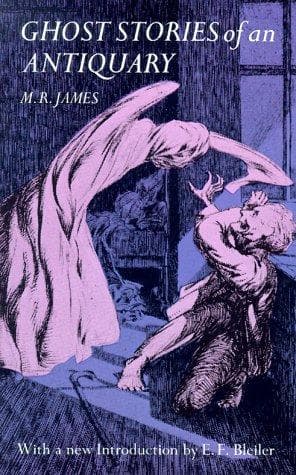
Ghost Stories of an AntiquaryJames, M. R. (Montague Rhodes)
General
Ghost Stories of an Antiquary
James, M. R. (Montague Rhodes)
Ghost stories, English; Horror tales, English; Short stories, English
So monsieur turned on, meeting new treasures at every rise of a leaf;
and at the end of the book he came upon two sheets of paper, of much
more recent date than anything he had yet seen, which puzzled him
considerably. They must be contemporary, he decided, with the
unprincipled Canon Alberic, who had doubtless plundered the Chapter
library of St Bertrand to form this priceless scrap-book. On the first
of the paper sheets was a plan, carefully drawn and instantly
recognizable by a person who knew the ground, of the south aisle and
cloisters of St Bertrand’s. There were curious signs looking like
planetary symbols, and a few Hebrew words in the corners; and in the
north-west angle of the cloister was a cross drawn in gold paint. Below
the plan were some lines of writing in Latin, which ran thus:
Responsa 12mi Dec. 1694. Interrogatum est: Inveniamne? Responsum est:
Invenies. Fiamne dives? Fies. Vivamne invidendus? Vives. Moriarne in
lecto meo? Ita. (Answers of the 12th of December, 1694. It was asked:
Shall I find it? Answer: Thou shalt. Shall I become rich? Thou wilt.
Shall I live an object of envy? Thou wilt. Shall I die in my bed? Thou
wilt.)
“A good specimen of the treasure-hunter’s record—quite reminds one of
Mr Minor-Canon Quatremain in _Old St Paul’s_,” was Dennistoun’s
comment, and he turned the leaf.
What he then saw impressed him, as he has often told me, more than he
could have conceived any drawing or picture capable of impressing him.
And, though the drawing he saw is no longer in existence, there is a
photograph of it (which I possess) which fully bears out that
statement. The picture in question was a sepia drawing at the end of
the seventeenth century, representing, one would say at first sight, a
Biblical scene; for the architecture (the picture represented an
interior) and the figures had that semi-classical flavour about them
which the artists of two hundred years ago thought appropriate to
illustrations of the Bible. On the right was a King on his throne, the
throne elevated on twelve steps, a canopy overhead, soldiers on either
side—evidently King Solomon. He was bending forward with outstretched
sceptre, in attitude of command; his face expressed horror and disgust,
yet there was in it also the mark of imperious command and confident
power. The left half of the picture was the strangest, however. The
interest plainly centred there. On the pavement before the throne were
grouped four soldiers, surrounding a crouching figure which must be
described in a moment. A fifth soldier lay dead on the pavement, his
neck distorted, and his eye-balls starting from his head. The four
surrounding guards were looking at the King. In their faces, the
sentiment of horror was intensified; they seemed, in fact, only
restrained from flight by their implicit trust in their master. All
this terror was plainly excited by the being that crouched in their
midst. I entirely despair of conveying by any words the impression
Public-domain text, read in full here on John Shaqi.
Reviews
Reviews
No reviews yet
Be the first to share your thoughts on this work.
Join the Discussion
Join the discussion
Sign in to leave a comment or review.
Sign InorCreate an account