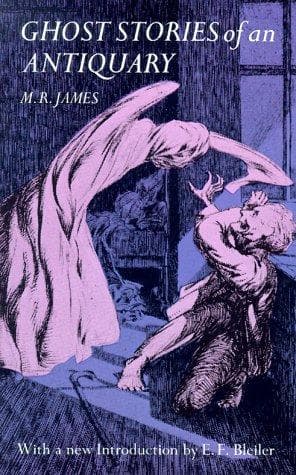
Ghost Stories of an AntiquaryJames, M. R. (Montague Rhodes)
General
Ghost Stories of an Antiquary
James, M. R. (Montague Rhodes)
Ghost stories, English; Horror tales, English; Short stories, English
In another infinitesimal flash he had taken it in. Pale, dusky skin,
covering nothing but bones and tendons of appalling strength; coarse
black hairs, longer than ever grew on a human hand; nails rising from
the ends of the fingers and curving sharply down and forward, grey,
horny and wrinkled.
He flew out of his chair with deadly, inconceivable terror clutching at
his heart. The shape, whose left hand rested on the table, was rising
to a standing posture behind his seat, its right hand crooked above his
scalp. There was black and tattered drapery about it; the coarse hair
covered it as in the drawing. The lower jaw was thin—what can I call
it?—shallow, like a beast’s; teeth showed behind the black lips; there
was no nose; the eyes, of a fiery yellow, against which the pupils
showed black and intense, and the exulting hate and thirst to destroy
life which shone there, were the most horrifying features in the whole
vision. There was intelligence of a kind in them—intelligence beyond
that of a beast, below that of a man.
The feelings which this horror stirred in Dennistoun were the intensest
physical fear and the most profound mental loathing. What did he do?
What could he do? He has never been quite certain what words he said,
but he knows that he spoke, that he grasped blindly at the silver
crucifix, that he was conscious of a movement towards him on the part
of the demon, and that he screamed with the voice of an animal in
hideous pain.
Pierre and Bertrand, the two sturdy little serving-men, who rushed in,
saw nothing, but felt themselves thrust aside by something that passed
out between them, and found Dennistoun in a swoon. They sat up with him
that night, and his two friends were at St Bertrand by nine o’clock
next morning. He himself, though still shaken and nervous, was almost
himself by that time, and his story found credence with them, though
not until they had seen the drawing and talked with the sacristan.
Almost at dawn the little man had come to the inn on some pretence, and
had listened with the deepest interest to the story retailed by the
landlady. He showed no surprise.
“It is he—it is he! I have seen him myself,” was his only comment; and
to all questionings but one reply was vouchsafed: “Deux fois je l’ai
vu; mille fois je l’ai senti.” He would tell them nothing of the
provenance of the book, nor any details of his experiences. “I shall
soon sleep, and my rest will be sweet. Why should you trouble me?” he
said.[2]
[2] He died that summer; his daughter married, and settled at St
Papoul. She never understood the circumstances of her father’s
“obsession”.
We shall never know what he or Canon Alberic de Mauléon suffered. At
the back of that fateful drawing were some lines of writing which may
be supposed to throw light on the situation:
Public-domain text, read in full here on John Shaqi.
Reviews
Reviews
No reviews yet
Be the first to share your thoughts on this work.
Join the Discussion
Join the discussion
Sign in to leave a comment or review.
Sign InorCreate an account