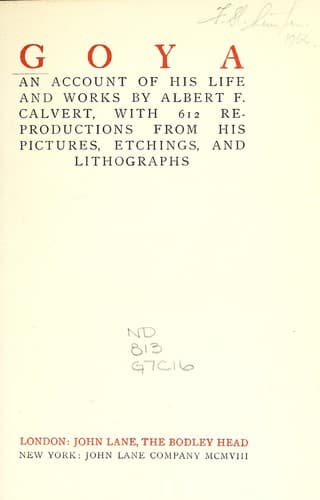
Goya, an account of his life and works — John Shaqi
Goya, an account of his life and worksCalvert, Albert Frederick
History
Goya, an account of his life and works
Calvert, Albert Frederick
Goya, Francisco, 1746-1828
Of Velazquez it has been said that he attained perfection in the realism
of detail and in the realism of sight, and in his commanding genius
Spanish art was emancipated from the fetters of pseudo-Italianism in
which it had laboured so long. He carried Spanish realism to its Ultima
Thule. Further his age could not go, and generations of artists who came
after him devoted themselves to the imitation and reproduction of his
colour and his technique with such passionate servility that in the end
the copy of the pupil was frequently mistaken for the work of the
master. The perfect technique of the great Court painter had, in his own
day, the effect of arresting artistic development--it left his
successors nothing to solve for themselves. He achieved so much in his
own work that, for a time, the last word in art seemed to have been
spoken. Until his influence had died away, the reproduction of Velazquez
was the aim of the Madrid painters. For this reason, after the death of
Velazquez, the artistic life of the seventeenth century became a spent
force, and for want of new impetus of original genius, Spanish art
steadily declined. The followers of the supreme painter failed to
realise the true inwardness of his message. They had the seed, but they
could raise no new flower. One feels towards the pictures of Velazquez
as Swinburne felt towards the muse of Sappho:
’ ... earth’s womb has borne in vain
New things, and never this best thing again;
Borne days and men, borne fruits and wars and wine,
Seasons and songs but no song more like mine.’
But the reverent desire to perpetuate ‘this best thing’ could not arrest
the decay of artistic inspiration. The disciples of Velazquez copied and
painted successfully (up to a point), and they trained other generations
of imitators who continued to work and teach their methods, until
imitation slowly but surely sank into artistic degradation. Under the
sway of Mariana of Austria, the decay of Spanish painting was further
hastened, and the ascendency of the facile, brilliant brush of Luca
Giordano, under Charles II., dealt the death-blow to the realistic
impulse that had carried the national school of the middle seventeenth
century to the realisation of its utmost ambition.
The decadence which followed the death of Velazquez was most pronounced
among the Castilian painters, but the empire of Giordano extended to the
Provincial schools and completed the more gradual decline of art in
Andalusia and Valencia. Seville was foredoomed to decadence as a school
of painting, for its artists had taken Murillo as their model, and in
servilely imitating the ‘Painter of the Conceptions,’ they emphasised
his faults, exaggerated his unreality, and caricatured his affectations.
The popular admiration of Murillo was all-powerful to hasten the general
decline, and each year the artistic outgrowth of Andalusia became more
enfeebled.
Public-domain text, read in full here on John Shaqi.
Reviews
Reviews
No reviews yet
Be the first to share your thoughts on this work.
Join the Discussion
Join the discussion
Sign in to leave a comment or review.
Sign InorCreate an account