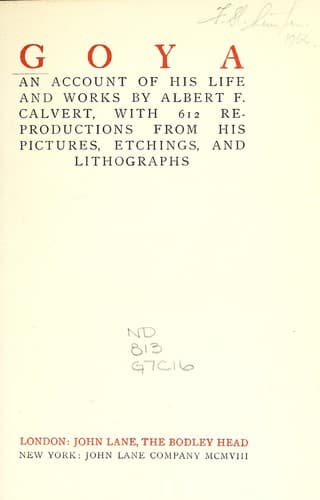
Goya, an account of his life and worksCalvert, Albert Frederick
History
Goya, an account of his life and works
Calvert, Albert Frederick
Goya, Francisco, 1746-1828
In the last months of the seventeenth century Charles II. died without
issue and the art-loving Austrian dynasty was ended. The succeeding
Bourbon sovereigns brought with them an art derived from France; they
had no ambition to reanimate the native art of the country. Madrid
became the only recognised art centre in Spain, and to Madrid, in 1761,
came, at the invitation of Charles III., Giovanni Battista Tiepolo, the
Venetian fresco-painter, and the Saxon pedant, Anton Raphael Mengs. The
Spanish painters who had rendered homage to the facile Giordano were
caught by the glamour of the fantastic, insincere art of Tiepolo, while
the dreary academic influence of Mengs--whose paintings are declared by
Carl Justi to echo the last shadow of eclectic mannerism--made for all
that is dull, exact, and lifeless in pictorial art. No great Spaniard
arose to counteract the demoralising influence of these imported
professors; it was realised in the studios of Madrid that the methods of
the favoured aliens led to popularity and fortune; the Spanish artists
followed the line of least resistance, nor desisted when they found that
it carried them ever further from the tradition founded by Velazquez.
This art, dull but without dignity, showy but meaningless, was the
reflex of the prevailing rottenness in the national life. During the
reign of Charles III. a certain superficial decency was observed; the
corruptness of Court life was kept out of sight; a general conspiracy of
make-believe was maintained. But under Maria Luisa of Parma and Charles
IV., the abomination of moral desolation in social, political and
artistic life was complete and confessed. Manuel Godoy, afterwards
Prince de la Paz, was Prime Minister of Spain, and the country was
demoralised by dissolute courtiers and unscrupulous ministers, and
drained by insatiable priests. But in the turmoil created by an
aristocracy sunk in lasciviousness, a government steeped in corruption,
and a commonalty beaten and bled into a state of nerveless resignation,
was heard the echo of the revolutionary movement which was sweeping over
Europe. The teaching of Goethe and Schiller, followed by the preaching
of Rousseau, had taken concrete form in the butcheries of Robespierre
and Danton; the movement had culminated in the personal supremacy of
Napoleon Buonaparte.
Public-domain text, read in full here on John Shaqi.
Reviews
Reviews
No reviews yet
Be the first to share your thoughts on this work.
Join the Discussion
Join the discussion
Sign in to leave a comment or review.
Sign InorCreate an account