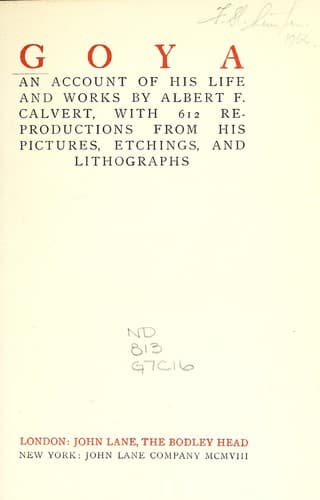
Goya, an account of his life and worksCalvert, Albert Frederick
History
Goya, an account of his life and works
Calvert, Albert Frederick
Goya, Francisco, 1746-1828
The fact that Spanish art reflects the aspirations and is largely
concerned with the representation of scenes selected by its chief
patron, the Spanish Catholic Church, accounts, in some measure, for the
lack of sympathy and appreciation with which it is regarded in this
country, but this prejudice does not explain the neglect from which Goya
has suffered. Goya, it is true, accepted commissions from the Church,
but his religious subjects do not comprise a tenth of his canvases, and
in his etchings and engravings he is seen only as a secular moralist. As
the painter of the Spanish Rococo period, he dipped his brush in beauty,
gaiety, and humour; as a portraitist he was vivid, surprising,
audacious, a maker of masterpieces; while his etchings constitute an
unrivalled commentary upon the spirit of the age, recorded by its ‘most
fearless and advanced thinker.’
Goya’s art would appear to be the reflection of his life. His youth was
disordered and tempestuous; in the height of his success he accepted
favours, but he was too conscientious an artist to repay the adulation
of the world by flattering it in his canvases; and he published his
disillusions in the biting satire of his Caprices and Proverbs.
The authorities I have consulted would make a formidable list, but among
those to whom I am under special obligation I must mention the ‘Lives’
of Goya by the Conde de la Viñaza, Paul Lefort, Paul Lafond, W.
Rothenstein, Richard Muther and Julius Hofmann; Valerian von Loga’s
works on Goya’s etchings and engravings; Don Juan de la Rada’s chapter
on ‘Goya’s Frescoes in the Church of San Antonio de la Florida;’
Muther’s appreciation of Goya in his _History of Modern Painting_;
Stirling-Maxwell’s _Annals of the Artists of Spain_; Carl Justi’s
‘Sketch of Spanish Art’ in Baedeker’s _Spain and Portugal_; C. Gasquoine
Hartley’s _Spanish Painting_; the _Boletin de la Sociedad Española de
Excursiones_; and Théophile Gautier’s brilliant study of Goya in his
_Travels in Spain_.
In making the collection of Goya’s works that is presented at the end of
this volume, I have taken the line of least resistance and included
reproductions of every picture, etching, or lithograph that I could
acquire. However inadequate photography and ‘process’ may be to convey
an impression of the original works, I have endeavoured to give English
students an opportunity of becoming acquainted with the subjects and
general nature of much of the output of Goya’s sixty years of artistic
effort.
Public-domain text, read in full here on John Shaqi.
Reviews
Reviews
No reviews yet
Be the first to share your thoughts on this work.
Join the Discussion
Join the discussion
Sign in to leave a comment or review.
Sign InorCreate an account