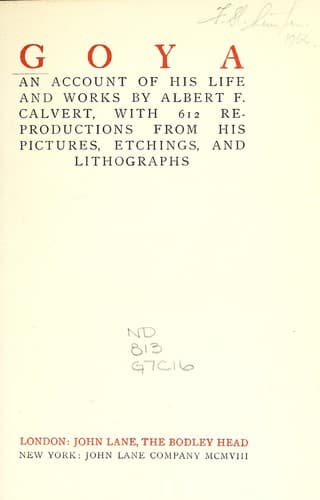
Goya, an account of his life and worksCalvert, Albert Frederick
History
Goya, an account of his life and works
Calvert, Albert Frederick
Goya, Francisco, 1746-1828
M. Matheron relates that the lad had been sent with a sack of wheat to a
neighbouring mill, when a monk of Zaragoza (probably Father Felix
Salvador of the Carthusian convent of Aula Dei) happened upon him. Goya,
seated on his burden, was intent upon drawing a pig with a piece of
charcoal upon a whitewashed wall. The priest, struck by the correct free
lines traced by the youngster, inquired who his master was and received
the characteristic reply: ‘I have none, your reverence. It is not my
fault, I cannot keep from drawing.’ The overmastering incentive pleaded
by the youthful delinquent never forsook him, and, although powerful
enemies resented his too free use of the pencil, and the Holy
Inquisition was moved to curb his unwearied industry, he continued to
ply brush and needle and gavel during sixty-eight years of changing,
strenuous life. Father Salvador remained Goya’s friend until his death.
He saw his father, and obtained permission from him, in 1760, for the
lad to go to Zaragoza. The imperial city exercised a powerful influence
upon his art. There is always in his pictures, as one of his countrymen
points out, the Zaragoza landscape, so rich in the contrasts of its
splendid and vigorous vegetation, recalling the banks of the Genil or
the Turia, while its limy hills and grey plains bring to the memory the
vistas of Castile. The melancholy of the sky--pierced by the severe
lines of innumerable towers and bounded by the austere distant
rock--remind us that here the sun has not the same suggested warmth that
supplied the rays for Murillo’s brush; that this is not the land of
fancy but the land of genius, cold as the snow of the Moncayo, that adds
beauty to the beautiful plants which produce not sweet odours but
healing balsams.
Thanks to the friendly offices of Father Salvador, Goya was admitted to
the studio of José Luzán y Martinez, whose religious and historical
pictures bear evidence of soft fresh colouring. He attended, too, the
school founded in 1714 by the sculptor Juan Ramirez, a pupil of the
well-intentioned Gregoria de Mesa. In the studio of Martinez, Goya, who
from the first betrayed his lifelong passion for realism, worked with
untiring ardour, stimulated, it may be, by the industry of his
co-pupils, José Beratón, Tómas Vallespin, and the Huesca jeweller,
Antonio Martinez, who founded, in Madrid, the silversmith’s business
which still bears his name. ‘In the schools of Zaragoza,’ says C.
Gasquoine Hartley, ‘he followed no conventional standards, and his
continuous study was directed to the development of his exuberant
individuality. To comprehend the truth, and afterwards to depict it, as
it pleased his ever-varying fancy, this was his great aim. His utterance
was inevitable and instinctive, the overflow of his dramatic,
inexhaustible and vivid imagination.’
Public-domain text, read in full here on John Shaqi.
Reviews
Reviews
No reviews yet
Be the first to share your thoughts on this work.
Join the Discussion
Join the discussion
Sign in to leave a comment or review.
Sign InorCreate an account