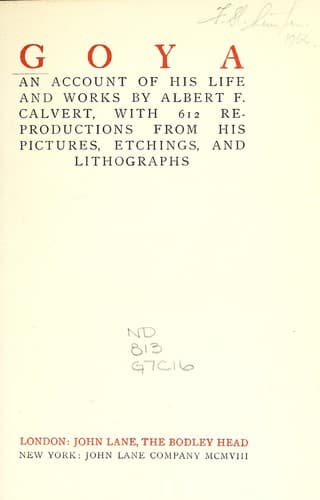
Goya, an account of his life and worksCalvert, Albert Frederick
History
Goya, an account of his life and works
Calvert, Albert Frederick
Goya, Francisco, 1746-1828
Goya, we are reminded, was a revolutionary; he was also a pitiless, if
quizzical, onlooker at the life of the Madrid Court. It was a simple
matter to him to transfer his allegiance from the Bourbons to Joseph
Buonaparte, and it was even more simple to welcome Ferdinand VII. to the
throne. ‘What did such changes matter in years of irretrievable ruin?’
writes C. Gasquoine Hartley, in _A Record of Spanish Painting_. The
question may be left for the individual to answer according to his own
fancy. And if Goya was, as some will find, an opportunist, a political
weathercock, and a moral Vicar of Bray, as an artist he was a great
reformative force. Alternately an idealist and a realist, he fought with
all the social forces and against the academic standards of the school
commanded by David and Mengs, destroying the debased conventions of
painting and freeing the brush from the domination of a clique. A
national artist _par excellence_, he gave lasting form to the
sentiments, customs and conditions of his country. A profound believer
in empiricism, a great humourist, sometimes impetuous and fantastic, at
other times holding fast to reality; a master of portraiture; fantastic,
inspired, spontaneous in his aquafortis etchings; he seized upon and
immortalised every aspect of the gruesome tragi-comedy which was played
in Spain in the last years of the eighteenth century.
Francisco José de Goya y Lucientes was born at the end of March (the
30th or 31st) 1746 at Fuentetodos near Zaragoza, in Aragon, the province
which gave to the nation poets like the ‘Spanish Horaces,’ historians
like Zurita, teachers like Gracián and Luzán, a scholar like Latassa,
and a statesman like the Conde de Aranda. Goya was baptized in the
Church of Our Lady of the Ascent, and the names given him by his
godmother, Francesca de Grasa, were Francis Joseph. The amiable weakness
for connecting great men with great families has prompted a German
biographer to claim that both his father and mother belonged to the
nobility, and that his first patron was the Duque de Fuentes. Less
imaginative authorities, however, tell us that his parents, José Goya
and Gracia Lucientes, were poor but hardworking peasants, and that when
‘the regenerator of the Spanish school of naturalistic painters’--to
quote the prefatory note to Goya’s pictures in the Prado catalogue--had
completed his course of elementary instruction at the hands of the
village schoolmaster, he was put to agriculture. A fortunate accident
revealed the bent of the lad’s genius and liberated him, at the age of
fourteen, from the drudgery of manual labour.
Public-domain text, read in full here on John Shaqi.
Reviews
Reviews
No reviews yet
Be the first to share your thoughts on this work.
Join the Discussion
Join the discussion
Sign in to leave a comment or review.
Sign InorCreate an account